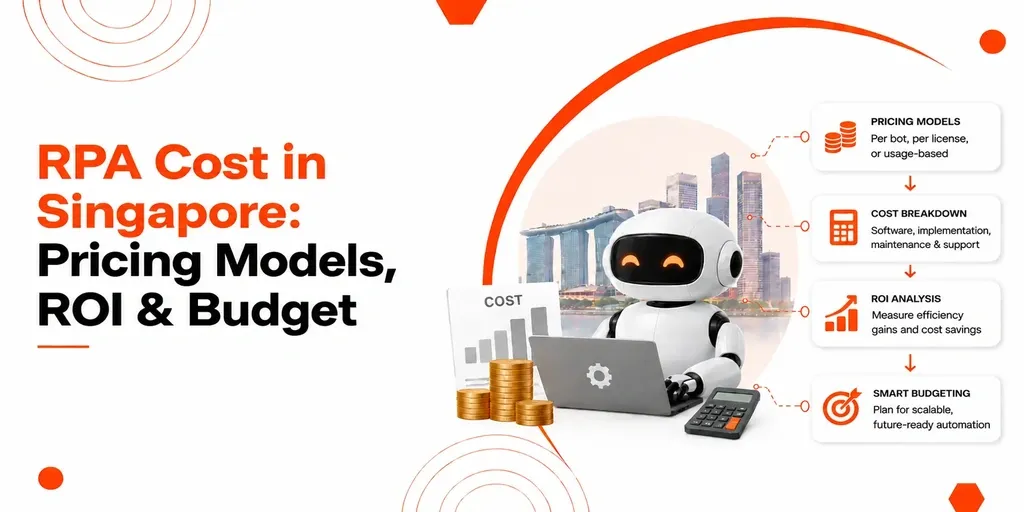
For a founder or CFO, automation is not a technology decision alone. It is a capital allocation decision.
You need to know what it will cost, how much value it can create, how long the payback period will be, and what costs may appear after launch.
The RPA cost in Singapore can range from a small five-figure investment for a focused automation project to a six-figure annual budget for a wider programme. The final figure depends on process complexity, the number of workflows, system integrations, security needs, support, and the pricing structure you choose.
The right question, then, is not simply, “What does RPA cost?”
A better question is, “What level of investment will deliver a measurable return for our business?”
This guide explains RPA pricing, budget planning, cost drivers, and RPA ROI in simple commercial terms.
Build Custom Software That Fits Your Business
From CRM to inventory systems — we design solutions around your workflow, not the other way around.
How Much Does RPA Cost in Singapore?
A small RPA project in Singapore may start at around S$15,000–S$40,000, while larger programmes can reach S$100,000–S$300,000 or more. These figures are planning ranges, not fixed market rates.
When CFOs ask how much RPA costs in Singapore, there is no single price that fits every company.
A business automating one stable finance task has different needs from a company automating dozens of workflows across finance, HR, operations, procurement, and customer service.
Typical Budget Ranges
For early budget planning, companies can think about investment in three broad bands:
| Project Type | Indicative Budget | Typical Scope |
| Small pilot | S$15,000–S$40,000 | 1–3 simple processes |
| Mid-sized programme | S$40,000–S$100,000 | Several workflows and integrations |
| Large programme | S$100,000–S$300,000+ | Multiple teams, systems and complex workflows |
These ranges can include process assessment, design, development, testing, deployment, and early support. Ongoing costs may sit outside the initial project budget.
For companies exploring RPA in Singapore, a pilot can be a sensible starting point. It allows management to test the business case before committing more capital.
What Factors Affect RPA Cost in Singapore?
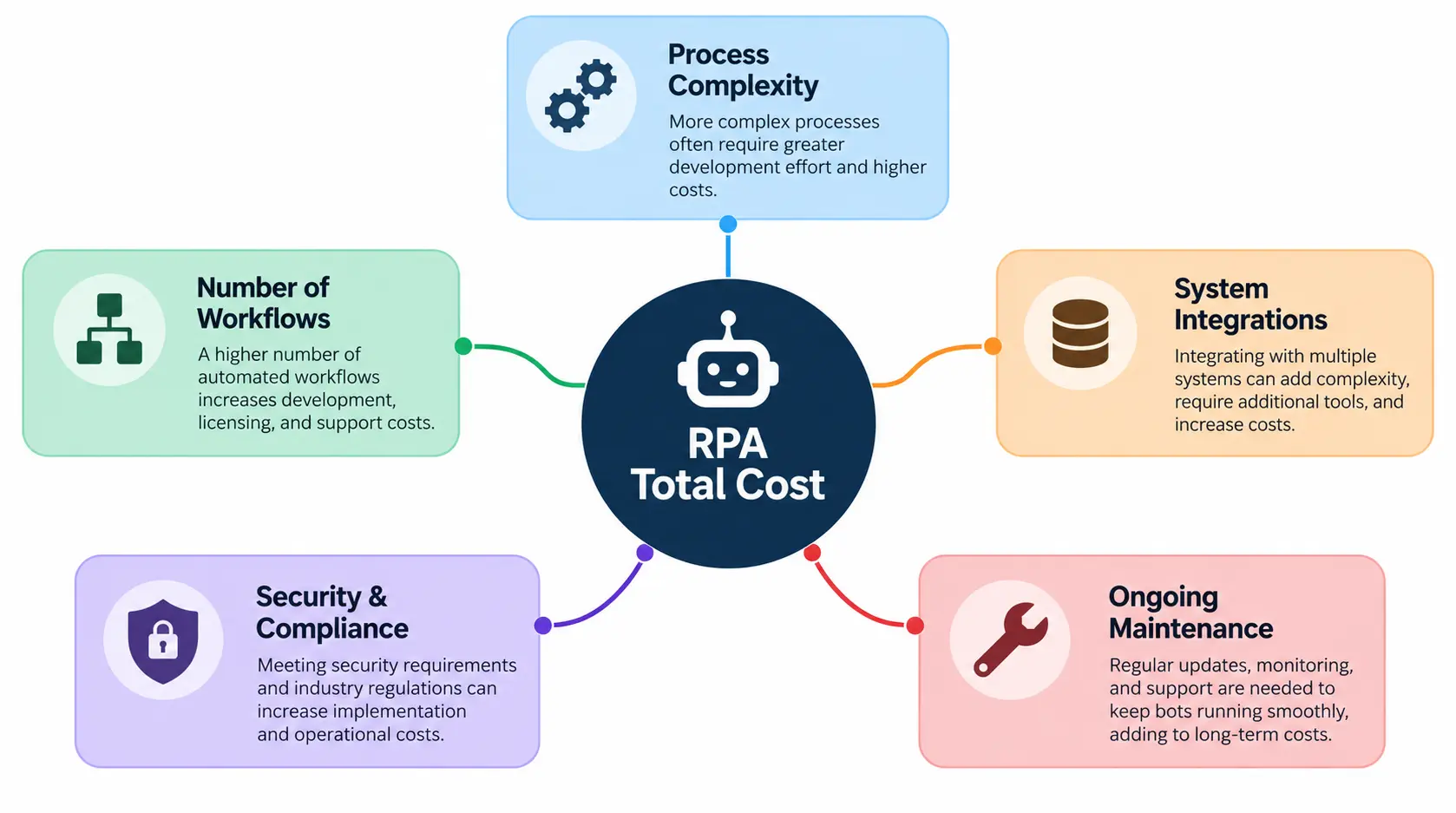
The main cost drivers are process complexity, automation volume, integration needs, security requirements, implementation effort, and ongoing maintenance.
Two companies can automate a process with the same goal and still receive very different estimates.
That is because the work behind the automation matters as much as the number of tasks involved.
Process Complexity
Simple, rule-based work costs less to automate.
For example, moving data between standard spreadsheets and business systems may require less development than a process involving many decision points, document types, exceptions, and approval paths.
The more exceptions a process has, the more time teams may need for design and testing.
Number of Processes
Automating one process requires a smaller budget than building a company-wide automation programme.
Yet cost does not always rise at the same rate as the number of processes.
Once governance, security controls, development standards, and support structures are in place, adding another workflow may cost less than building the first one.
System Integrations
Automation that works across several business systems can require more design and testing.
Older systems may also create extra work. If a company relies on custom software, legacy applications, remote desktops, or systems with limited integration options, project costs can rise.
Security and Compliance
Companies in finance, healthcare, insurance, government-linked sectors, and other regulated industries may need stronger controls.
These can include access management, audit records, testing standards, data protection controls, and approval processes.
Such requirements should be part of the budget from the start.
Maintenance Needs
Business processes change.
A form may get a new field. A system interface may change. A finance team may update an approval rule.
Automation must keep pace with these changes.
A realistic RPA cost in Singapore budget should include maintenance rather than treating launch as the end of the investment.
Which RPA Pricing Model Should You Choose?
The best pricing model depends on how predictable your automation needs are, how much internal capability you have, and whether you want a fixed project or an ongoing programme.
There are several ways companies can structure RPA pricing.
Understanding the commercial model helps CFOs compare proposals on equal terms.
Fixed-Price Projects
Under a fixed-price model, the business agrees on a defined scope and price before work starts.
This model can suit a pilot or a process with clear requirements.
It gives finance teams greater budget certainty. The drawback is that scope changes can lead to extra charges.
Time-Based Pricing
Under this structure, the business pays for the time required to design, build, test, and support the automation.
It can work well when requirements may change during the project.
The trade-off is less cost certainty.
Strong project controls are important so that changes in scope do not push the budget beyond the approved level.
Subscription-Based Pricing
Some automation arrangements use monthly or annual charges.
This can spread costs over time and make budgeting easier.
However, CFOs should review the total multi-year cost rather than focusing on the monthly fee.
A low entry price can become expensive when usage, workflow volume, infrastructure, or support requirements grow.
Managed Service Pricing
In a managed service model, an external team handles some or most of the automation lifecycle.
The fee may cover development, monitoring, maintenance, support, and improvements.
This model may suit businesses that want automation without building a large internal team.
When RPA pricing models explained in proposals look similar, compare what is included rather than the headline price alone.
What Should Be Included in an RPA Budget?
A complete RPA budget should cover assessment, implementation, infrastructure, testing, training, governance, maintenance, support, and future changes.
One common budgeting mistake is to focus on development costs.
That gives an incomplete picture.
Initial Project Costs
The first budget should cover process discovery, requirements, solution design, development, testing, deployment, and project management.
These costs form the base investment required to get automation into production.
Infrastructure and Access Costs
Some businesses may need additional computing capacity, environments, access controls, security work, or system changes.
These costs can be small for a simple project but material for a larger programme.
Training and Change Management
People still matter.
Employees need to understand which tasks will change, how exceptions will be handled, and who owns each automated process.
Training also helps teams identify better automation opportunities in the future.
Support and Maintenance
Set aside an annual support budget.
A useful financial model should include expected maintenance across the full investment period.
If you are comparing RPA pricing models explained by different providers or internal teams, check whether support is included or charged as a separate item.
How Can CFOs Calculate RPA ROI?
RPA ROI compares the financial benefit created by automation with the total cost of implementing and running it.
A simple calculation is:
RPA ROI = (Total Financial Benefit − Total RPA Cost) ÷ Total RPA Cost × 100
The calculation itself is easy. The challenge is deciding which benefits should count.
Labour Capacity Savings
Start with the hours spent on the process today.
Suppose a finance process takes 200 staff hours per month. If automation removes 150 of those hours, you have 1,800 hours of annual capacity.
Multiply those hours by the fully loaded hourly employee cost.
This creates a base value for your business case.
Capacity savings do not always mean headcount reduction. The value may come from allowing existing employees to handle more work without new hires.
Error Reduction
Errors have a cost.
They can lead to rework, refunds, penalties, payment delays, customer complaints, and management time.
If automation reduces avoidable errors, estimate the current annual cost of those errors and the share that the project could remove.
Faster Processing
Speed can also create financial value.
Faster invoice processing may improve payment control. Faster onboarding can help teams serve customers sooner. Faster reporting can give management more time to act on financial information.
Use measurable outcomes where possible.
Avoided Hiring
Growth can increase transaction volume without increasing revenue at the same pace.
Automation may allow a company to absorb that growth without adding the same number of employees.
For many CFOs, avoided future hiring is one of the strongest parts of the RPA ROI case.
What Do RPA ROI Calculation Examples Look Like?
A useful ROI example should compare annual financial benefits against both the initial investment and recurring operating costs.
Consider a company that invests S$50,000 in automating several finance processes.
The automation saves 2,000 staff hours per year. Assume the fully loaded value of that time is S$35 per hour.
Annual capacity value:
2,000 × S$35 = S$70,000
The company also saves S$15,000 per year through lower rework and error costs.
Total annual benefit:
S$70,000 + S$15,000 = S$85,000
If the first-year project cost is S$50,000:
RPA ROI = (S$85,000 − S$50,000) ÷ S$50,000 × 100
RPA ROI = 70%
The simple payback period would be about seven months.
These RPA ROI calculation examples become more useful when you add recurring costs.
If annual maintenance costs are S$10,000, the ongoing net benefit would be S$75,000 before other changes.
For a CFO, this is a more useful view than a headline savings figure.
How Can You Build a Realistic RPA Business Case?
Build the business case from measurable process data, conservative benefit assumptions, full lifecycle costs, and a clear payback target.
A strong business case should survive scrutiny from finance, operations, and leadership.
Start With High-Volume Work
Look for tasks that consume large amounts of staff time.
The best candidates operate through repeated actions that follow exact rules and maintain consistent behavior while handling numerous cases.
The process of saving small amounts of money during multiple repeated tasks creates more value than saving a lot on a single uncommon task.
Measure the Current Cost
Before estimating savings, understand the current process.
The evaluation process requires staff hours measurement together with transaction volume assessment, error rate analysis, rework tracking, delay monitoring, and all other operational expenses must be included.
RPA ROI calculation examples look impressive through baseline-free analysis, yet they create no link between financial results and business operations.
Use Conservative Assumptions
A case should not be built which assumes that every saved hour will result in cash conversion.
The benefits should be divided into different groups, which include cash savings and avoided hiring, staff capacity, risk reduction, and service improvement.
The system provides decision-makers with better project delivery information that they need to make decisions.
Model More Than One Scenario
Build a downside, base, and upside case. For example, the downside case could assume lower time savings and higher maintenance costs.
The upside case could assume stronger adoption and more automation volume. This helps founders and CFOs understand both the return and the risk.
When Does RPA Become Too Expensive?
RPA becomes too expensive when the cost of building and maintaining automation is higher than the measurable value of the process being automated.
Not every process should be automated.
A low-volume task with many exceptions may deliver poor returns. The same is true for a process that is expected to change in a few months.
Poor Process Selection
Automating a broken process can make the problem more expensive.
In some cases, simplifying or removing steps creates more value than automation.
High Maintenance Burden
If a workflow depends on systems that change often, support costs may become significant.
Include this risk when comparing project options.
Weak Business Ownership
Automation needs an owner.
Someone should be accountable for process changes, exceptions, controls, and performance.
Without ownership, even a technically successful project can lose value over time.
How Should Founders and CFOs Set Their RPA Budget?
Start with a defined business problem, set a target payback period, fund a controlled pilot, and expand only when the results support further investment.
The best starting budget is not the largest one your business can afford.
It is the smallest investment that can prove the commercial case.
Choose one to three processes with enough volume to produce measurable savings. Set clear targets for cost, time saved, error reduction, and payback.
Then measure actual results.
If the pilot delivers the expected value, the company can expand with more confidence.
For businesses assessing RPA in Singapore, this staged approach can reduce financial risk while building internal knowledge.
It also turns automation from a technology experiment into an investment programme with clear financial controls.
What Should You Remember Before Investing in RPA?
Focus on total cost, measurable value, payback period, and maintenance before making an investment decision.
Review the Full Cost
The RPA cost in Singapore depends on process complexity, systems, controls, and business needs. When comparing RPA pricing, include implementation, infrastructure, support, maintenance, and future changes.
Measure the Real Return
A lower price does not always mean better value. Assess RPA ROI based on cost savings, staff capacity, fewer errors, and faster processing. Keep direct savings separate from other business benefits.
Build a Clear Business Case
Use realistic assumptions for costs and expected savings. Start with repetitive, high-volume processes that offer measurable value. For founders and CFOs, a clear business case makes it easier to set the right budget and justify further investment.
Conclusion
Overall, the right RPA investment is one that delivers measurable savings, a clear payback period, and enough long-term value to justify its total cost.
Founders and CFOs need to begin their decision process by assessing business value instead of focusing on technological aspects. The complete RPA expense for Singapore includes all costs from implementation to ongoing support and maintenance, infrastructure needs and future system modifications.
Your choice of RPA cost model in Singapore also matters. The initial payment amount does not determine the entire expense for this product or service. Organizations need to evaluate different options from various time periods to understand what each price point includes.
RPA becomes a planned investment after organizations create a definite business case that includes specific targets to measure its success.