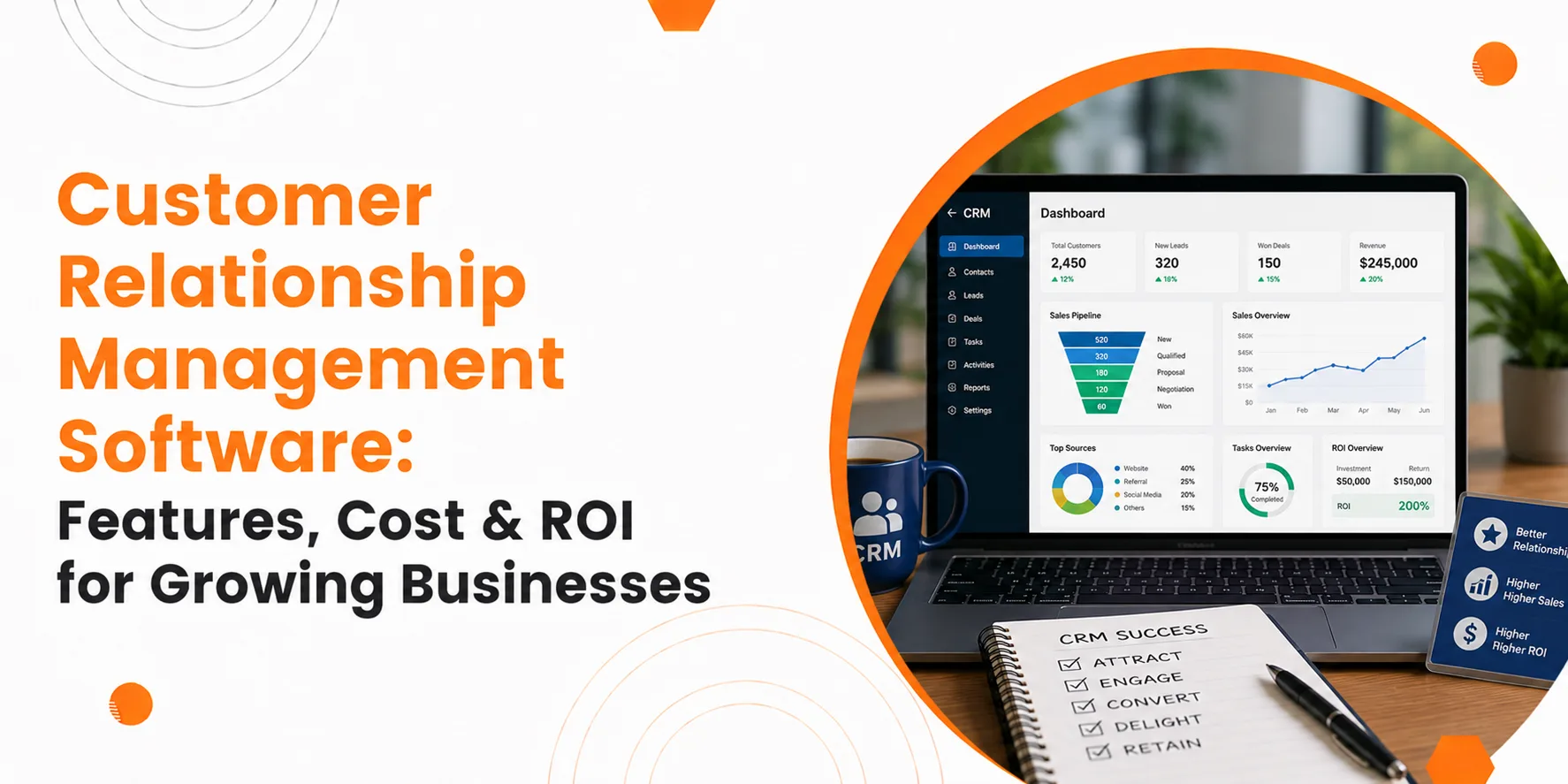
Growing a business means managing more customers, leads, conversations, and sales opportunities. Keeping all this information organised can become difficult as your customer base expands.
That’s why Customer Relationship Management Software came into the picture, which gives businesses one platform to manage customer data, sales activities, communication, and follow-ups. It can help teams stay organised, reduce manual work, and build stronger customer relationships.
For growing businesses, the key question is not only whether they need a CRM. They also need to understand its features, costs, and potential return on investment.
This guide explains what CRM does, which features matter, what affects its price, and how to measure its value.
Build Custom Software That Fits Your Business
From CRM to inventory systems — we design solutions around your workflow, not the other way around.
What Is Customer Relationship Management Software?
Customer Relationship Management Software is a system that helps businesses store customer information, manage interactions, track sales opportunities, and organise customer-facing activities in one place.
Without a shared system, important information can sit in emails, spreadsheets, notebooks, and individual inboxes. Team members may not know who contacted a customer or what was discussed.
A Customer Relationship Management System creates a shared record which contains contact details, past conversations, sales activity, notes, tasks, and deal information.
How Does a Customer Relationship Management System Work?
A CRM collects customer information and turns it into organised records that sales, marketing, service, and management teams can use.
A typical customer journey might start when someone completes a form, sends an enquiry, calls the business, or contacts a sales representative.
The CRM can create a customer or lead record. The team can then record calls, emails, meetings, notes, tasks, and sales progress.
What does a simple CRM process look like?
A basic process may look like this:
New enquiry → Lead record → Follow-up → Sales opportunity → Proposal → Customer → Ongoing relationship
For example, imagine a prospect asking for a quote.
The salesperson enters all prospect information into the CRM system. They capture the requirements through documentation, and they establish a scheduled follow-up appointment. The salesperson updates the opportunity record when the prospect sends a reply.
So, businesses maintain all customer history within the same system, which stores prospect information after they become customers.
The system allows new employees to continue customer conversations without needing to learn about previous interactions.
Why Do Growing Businesses Need CRM Software?
Growing businesses need CRM software because customer information and sales processes become harder to manage as the number of leads, customers, and employees increases.
Spreadsheets may work when a business has a small customer base. Problems can appear when several people need to update the same information.
A sales representative might forget a follow-up. Two employees might contact the same lead. A manager might struggle to see which deals are close to closing.
CRM helps create a structured process.
Singapore businesses need to understand this connection because they must handle their growing sales workforce, market expansion, and increasing customer base.
Teams can access a single database of customer information through CRM systems, which they would otherwise need to retrieve from various files and communication platforms.
What Are the Most Important CRM Features for SMEs?
The most useful CRM features for SMEs include contact management, lead tracking, sales pipelines, task management, communication history, reporting, workflow tools, and integrations.
Businesses do not always need a long list of complex features; instead, sometimes they need features that solve real problems. Below are some of the most useful CRM features for SMEs.
Contact Management
Contact management stores customer and prospect information in one organised location. A customer record may include:
- Name and contact information
- Company details
- Previous conversations
- Meeting notes
- Tasks
- Sales opportunities
- Purchase history
- Account status
Employees can check the record before contacting a customer. This helps them understand the relationship and avoid asking for information the customer has already provided.
Lead Management
Lead management helps sales teams capture, organise, assign, and track potential customers. Teams can see which leads need attention and where each prospect sits in the sales process, which reduces the risk of enquiries being forgotten. It also helps managers understand how leads move from first contact to sale.
Sales Pipeline Management
A sales pipeline shows active opportunities at different stages of the sales process. Common stages could include:
New lead → Qualified → Meeting → Proposal → Negotiation → Won or Lost
Salespeople can see which opportunities need action. Managers can see the value of active deals and identify where opportunities are getting stuck.
Task and Activity Management
CRM systems can help teams manage calls, meetings, follow-ups, and other customer-related tasks.
Instead of relying on memory, employees can see what they need to do and when they need to do it.
This can create a more consistent sales process.
Communication History
Customers may communicate with several people during their relationship with a business. Keeping a history of those interactions gives employees useful context.
For example, a new account manager can review previous notes before speaking with an existing customer.
The customer does not have to repeat the same story each time.
Reporting and Analytics
CRM reports can show managers what is happening across the sales process.
Depending on the system, reports may cover:
- Leads generated
- Conversion rates
- Sales pipeline value
- Deals won and lost
- Sales activity
- Revenue
- Sales forecasts
This information can help managers find problems and make informed decisions.
Integrations
A CRM rarely works alone. Businesses may need it to connect with email, accounting systems, websites, customer support systems, or other business applications. Useful integrations can reduce duplicate data entry and make information easier to access.
When comparing CRM Solutions in Singapore, businesses should check whether a system can connect with the applications they already use.
How Much Does Customer Relationship Management Software Cost?
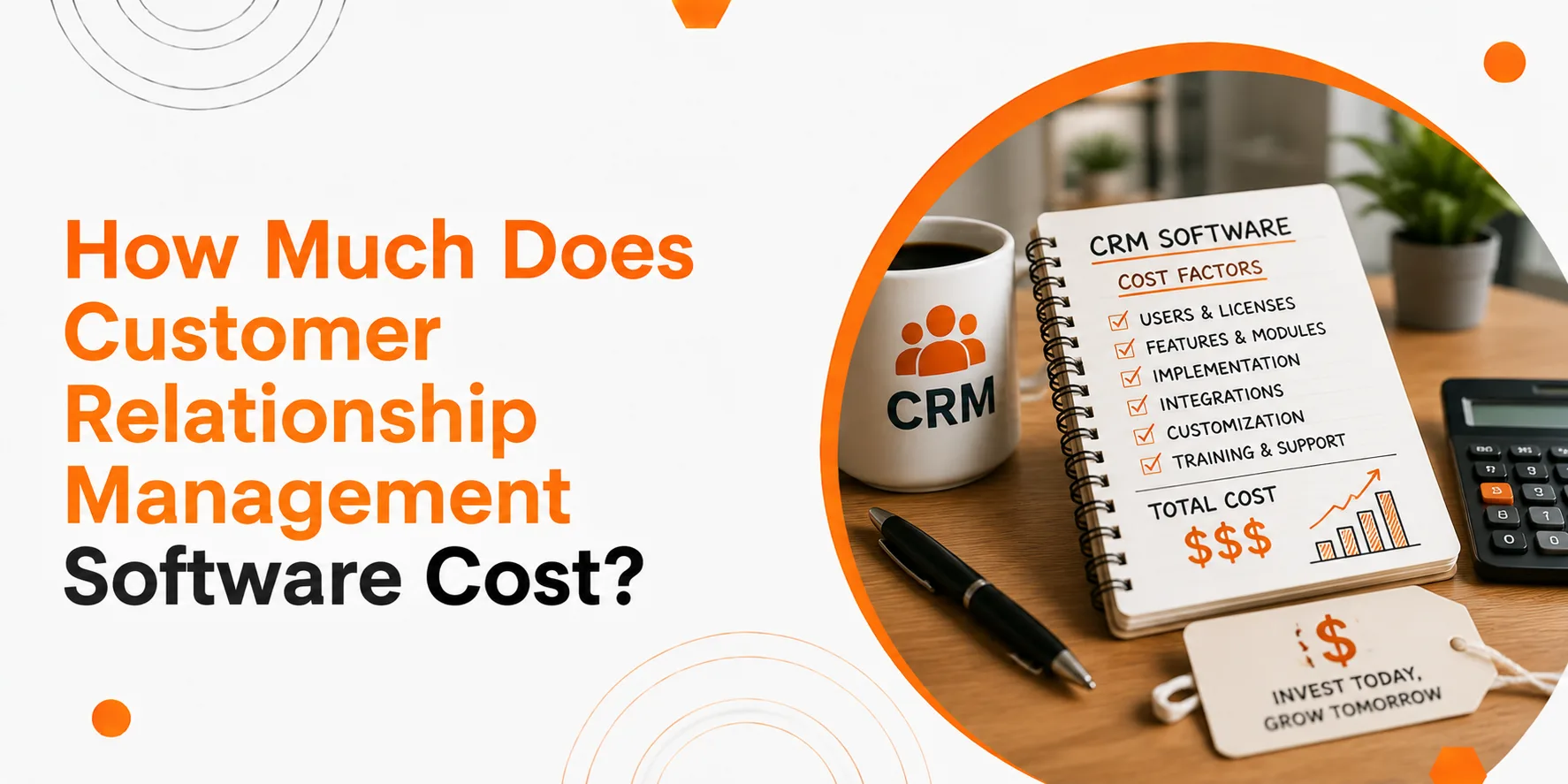
Customer Relationship Management Software Cost depends on the number of users, required features, level of customisation, integrations, data migration, training, and ongoing support.
There is no single price that applies to every business.
Some systems charge a monthly fee for each user. Others use packages based on features, customer records, usage, or business size.
The subscription price is only one part of the total cost.
What costs should businesses consider?
A business may need to budget for:
- Software subscriptions
- Setup and configuration
- Data migration
- Custom fields and workflows
- Integrations
- Employee training
- Technical support
- Maintenance
- Future upgrades
This is why comparing systems based only on the advertised monthly fee can be misleading.
A low-cost system may become expensive if the business needs several paid add-ons or extensive custom work.
What affects CRM costs for growing businesses?
The number of users is one of the main factors. A five-person sales team may have different needs from a company with 50 sales and service employees. Feature requirements also matter.
A small business may need contact management, pipelines, tasks, and basic reporting. A larger company may require advanced permissions, multiple pipelines, detailed reporting, or complex integrations.
Before estimating Customer Relationship Management Software Cost, businesses should define what they need today and what they may need as they grow.
What Is CRM ROI?
The CRM ROI calculation shows how much money a business earns through CRM implementation after deducting all expenses related to the system.
The acquisition of CRM software fails to generate returns because it functions independently from other operational elements. The system delivers value through employee proficiency in its operation and its ability to enhance business operations.
A company can use CRM software to react to new leads more quickly while it prevents lost follow-up messages, shortening the time needed to close sales and boosts customer loyalty.
The changes in this area will lead to two main outcomes, which include increased revenue generation and decreased operational expenses.
How Can CRM Improve ROI for a Growing Business?
CRM systems help businesses increase their return on investment through revenue growth, time savings, better conversion performance, and customer retention enhancement.
The actual output depends on how businesses operate their sales processes and their system operation practices.
Reduce Administrative Work
Sales staff members dedicate their time to update spreadsheets while they search for customer information, create reports, and review previous communication records. A CRM system allows users to unite all their data into a single platform for better information management.
The elimination of repetitive administrative tasks enables staff members to dedicate their time toward client interactions and sales operations.
Improve Conversion Rates
The sales process becomes more structured, which helps businesses find their most important leads.
Sales teams can monitor their follow-up activities while checking their deal progression, and they can direct their attention toward their current active deals.
A business that receives many leads can achieve major effects through even small increases in its conversion rate.
Support Customer Retention
Keeping an existing customer can be as important as winning a new one. CRM data enables teams to track customer interactions along with their complete history of reported problems, previous purchases, and all their recorded discussions.
With data, businesses can manage their accounts better while they deliver suitable messages to their customers.
Improve Sales Forecasting
Sales pipeline information enables managers to identify their upcoming sales possibilities. Managers can review the number of opportunities, their value, and their current stage.
The business achieves better visibility, which enables them to make decisions about their hiring needs, budget allocation, and inventory management.
How Should SMEs Measure CRM ROI?
SMEs should measure CRM ROI by comparing business performance before and after implementation using clear sales, productivity, and customer metrics. Businesses should decide which measurements matter before introducing a new CRM.
Useful metrics may include:
- Lead response time
- Lead-to-customer conversion rate
- Average deal size
- Length of the sales cycle
- Revenue per salesperson
- Number of missed follow-ups
- Customer retention rate
- Administrative hours saved
- Sales forecast accuracy
Tracking these figures creates a baseline.
After implementation, the business can compare new results with the baseline to understand whether the system is creating value.
This makes CRM ROI a business measurement rather than a vague promise.
How Do You Know When Your Business Needs a CRM?
A business may need CRM when customer information becomes difficult to manage, sales opportunities are being missed, or teams lack a clear view of customer activity.
There is no fixed company size at which CRM becomes necessary. The warning signs matter more than employee numbers.
For example, it may be time to consider CRM when:
- Customer details are spread across spreadsheets and inboxes
- Employees miss follow-ups
- Sales opportunities are difficult to track
- Managers cannot see the current pipeline
- Customer information is duplicated
- New employees struggle to understand account history
- Reporting requires manual work
- Different departments hold different customer records
A business experiencing several of these problems may have outgrown its current process.
How Should Businesses Choose CRM Software in Singapore?
Businesses should choose CRM Software in Singapore based on their sales process, team size, required features, integrations, ease of use, support needs, security requirements, and budget.
The right system is not always the one with the most features. A complex platform can create problems if employees find it difficult to use. Start with business requirements.
What questions should you ask before choosing a CRM?
Ask questions such as:
- Which customer information do we need to store?
- How many employees will use the system?
- Which sales stages do we need?
- What reports do managers need?
- Which existing systems need to connect with the CRM?
- How much training will employees require?
- Can the system support more users as we grow?
- What is the full cost over one to three years?
Businesses comparing CRM Solutions in Singapore should also consider local support, implementation requirements, data management needs, and the ability to scale.
These factors can be as important as the feature list.
What Mistakes Should Businesses Avoid When Implementing CRM?
The most common CRM mistakes include unclear goals, poor-quality data, complex processes, weak training, and low employee adoption.
Technology cannot fix a broken process on its own. A business should know what it wants to improve before implementing CRM.
Why should you avoid adding too many features?
More features can create more complexity. Start with the functions employees need for their daily work.
For many smaller companies, the core CRM features for SMEs may include contacts, leads, pipelines, tasks, reporting, and communication records. Other capabilities can be introduced as requirements grow.
Why does employee adoption matter?
A CRM only provides useful information when employees keep it updated.
If salespeople continue storing customer information in private spreadsheets or personal notes, the system will contain incomplete data. Training should focus on practical daily tasks.
Employees need to understand how the system makes their work easier, not just how each feature works.
Why should data be cleaned before migration?
Old customer databases may contain duplicate contacts, outdated details, missing fields, or inconsistent formats.
Moving poor-quality information into a new system does not solve the problem. Clean and organise important data before migration.
What Should You Look for in the Best CRM Software in Singapore?
The Best CRM Software in Singapore should match your business processes, be simple for employees to use, provide the features you need, and support future growth without creating unnecessary cost or complexity.
There is no universal “best” CRM for every company. A small sales team may value simplicity and fast setup. A growing company may need stronger reporting, permissions, integrations, and workflow controls. When evaluating the Best CRM Software in Singapore, focus on practical business needs rather than the longest feature list.
Consider usability, scalability, support, integrations, data security, implementation requirements, and total ownership cost. A system that employees use every day can deliver more value than a feature-heavy platform that teams avoid.
How Can Businesses Get More Value From Their CRM?
Businesses can get more value from CRM by keeping data clean, creating simple processes, training employees, tracking key metrics, and reviewing how the system is used.
CRM implementation should not end when the software goes live.
Customers need change. Sales processes change. Teams grow.
Review the system at regular intervals.
Look for fields nobody uses, reports that no longer matter, repetitive tasks, and stages that slow down the sales process.
Keep the CRM focused on information that helps employees serve customers and move opportunities forward.
Is Customer Relationship Management Software Worth the Investment?
Customer Relationship Management Software can be a worthwhile investment when it solves clear business problems and produces measurable improvements in sales, productivity, customer management, or retention.
For a growing business, managing customer relationships through separate spreadsheets, inboxes, and personal notes can become difficult.
A well-planned Customer Relationship Management System provides structure. It gives teams one place to manage customer information, follow-ups, opportunities, and sales activity.
Cost still matters. Businesses should look beyond the monthly subscription and consider implementation, training, integrations, support, and future requirements.
The same applies to ROI. A CRM should be measured against real outcomes, such as better conversion rates, fewer missed opportunities, time saved, stronger retention, and increased revenue.
For companies considering CRM Software in Singapore, the goal should not be to buy the system with the most functions. The goal is to choose one that employees can use, that fits existing processes, and that can support the next stage of growth.
The right CRM should make customer management simpler as the business becomes more complex.