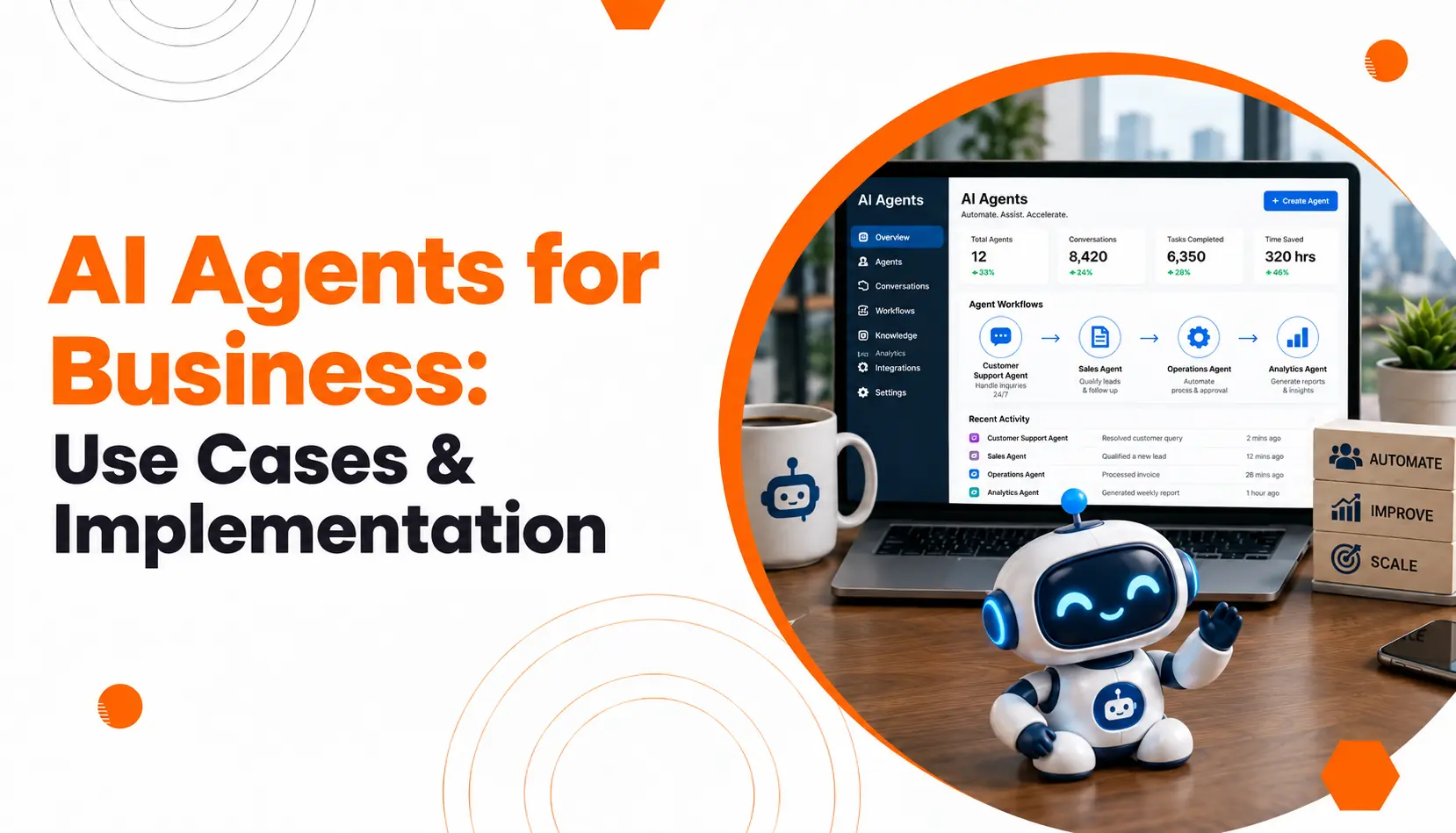
For many Ops and IT teams, the next stage of automation is not another chatbot or dashboard. It is software that can take a goal, work through a set of steps, use business data, and complete tasks with set controls.
This is why AI agents for business have become a key topic for companies looking at automation and software development.
An agent can handle work that once required staff to move between systems, check information, make simple decisions, and pass tasks to the next person. It can support customer service, finance, IT, sales operations, supply chains, and internal processes.
For businesses in Singapore, the opportunity is clear. Labour costs are high, digital adoption is strong, and many firms already have mature business systems. The challenge is not finding another piece of software. It is making existing systems work together with less manual effort.
This guide explains common AI agent examples for business, where agentic systems fit, how implementation works, and what Ops and IT leaders should consider before starting a project.
Build Custom Software That Fits Your Business
From CRM to inventory systems — we design solutions around your workflow, not the other way around.
What Are AI Agents for Business?
AI agents for business are software systems built to perform tasks towards a defined goal.
Traditional automation follows fixed rules, while an agent can work with more context. It may review an input, choose an action, use approved information, complete part of a process, and decide what should happen next.
The goal is not to remove people from every process but the goal is to reduce repetitive work while keeping people involved in decisions that need judgment, approval, or accountability.
From Fixed Workflows to Goal-Based Work
Think about a support ticket because a basic workflow might send the ticket to a department based on a word in the subject line.
An agentic system could read the full request, check account details, review earlier cases, identify the type of problem, draft a response, update the ticket, and send complex cases to the right person.
This type of system is often described as agentic AI because it can take a series of actions rather than produce a single response.
For Ops teams, this can mean fewer handovers, but for IT teams, it can mean stronger links between business systems and less pressure to build a separate workflow for every case.
Why Are Businesses in Singapore Exploring Agentic Systems?
Singapore companies have spent years moving processes into digital systems, but the real challenge is often integration.
A company may have separate systems for finance, customer records, operations, inventory, HR, and support. Staff still copy data between them or check several screens before making a simple decision.
This creates delays and increases the risk of mistakes. Agentic AI use cases in Singapore often focus on these gaps.
Pressure to Improve Operating Efficiency
Many firms want to grow without adding the same level of headcount to support functions. Automation can help teams process more work with the people they already have.
The value is strongest when a process has high volume, clear rules, and enough digital data to support decisions.
Strong digital foundations
Many Singapore businesses already use cloud systems, APIs, data platforms, and digital workflows. These foundations can make AI agent development easier because an agent needs safe access to business information and approved actions.
A company with well-structured systems may not need to rebuild its technology stack. It may need a controlled layer that connects existing systems and manages tasks between them.
Demand for Better Service
Customers and staff expect fast answers, as they also expect accurate information.
Agents can support service teams by gathering context before a person reviews a case. They can also handle simple requests from start to finish when the process has low risk.
What Are the Best AI Agent Examples for Business?
The best use cases tend to have a clear business goal. They also involve repeated steps that staff complete many times each day.
Here are several AI agent examples for business that Ops and IT teams can consider.
Customer Service Operations
An agent can classify incoming requests, find account information, check past conversations, prepare responses, and suggest the next action.
For simple cases, it may complete the request within approved limits, while complex or sensitive cases can go to a person.
This reduces the time service staff spend searching for information.
IT Service Management
IT teams receive many repeated requests. These may include access questions, account issues, device problems, or software support.
An agent can collect technical details, check known issues, suggest steps, create tickets, and send cases to the right support group.
It can also gather useful information before a technician starts work.
Finance Operations
Finance teams often handle invoices, payment queries, account checks, and reporting tasks.
An agent can read incoming documents, match information with internal records, flag missing details, and prepare items for approval.
Controls remain important. Payments and high-risk actions should use clear approval rules.
Sales Operations
Sales staff may spend a large part of their time on administration.
Agents can help update customer records, prepare meeting notes, check account history, create follow-up tasks, and organise information for sales teams.
The purpose is not to replace the salesperson. It is to reduce work around the sales process.
Procurement and Supply Chain
An agent can monitor order data, review supplier information, flag delays, and help staff respond to common supply issues.
It can also gather information from several systems before an Ops manager makes a decision.
This is useful where staff spend time checking stock, orders, suppliers, and delivery records across different systems.
How Does Agentic AI Differ From Standard Automation?
Standard automation works well when the process is predictable.
For example, a rule can state that every approved invoice under a set value goes to the next processing stage.
Agentic systems are useful when the route depends on context.
Greater Flexibility Within Clear Limits
An agent could review an invoice, compare it with a purchase order, identify a mismatch, check earlier records, and decide whether the case needs human review.
The process is still controlled, as the difference is that the system can respond to more than one fixed condition.
Use of Several Systems
Many business processes do not live in one place.
An agent may need information from a CRM, finance system, internal database, and support platform before it can complete one task.
This is where custom software becomes important. Off-the-shelf systems may cover part of the process, but a custom layer can connect the agent to the systems and rules that matter to the business.
A custom software development guide can help teams assess system architecture, integrations, security, user roles, and long-term support before development starts.
How Should Businesses Choose Their First Agent Use Case?
Starting with the most complex process creates risk.
A better first use case has a clear result and limited scope.
High-Volume Manual Work
Look for work that happens many times each week.
Repeated checks, data entry, ticket sorting, document review, and status updates are common starting points.
If a process takes ten minutes but happens hundreds of times, the savings can become significant.
Clear Inputs and Outputs
The agent should know what information it receives and what result it must produce.
A vague goal such as “improve operations” is hard to build around.
A goal such as “classify support requests and prepare a response for staff approval” is much easier to test.
Low-Risk Actions
Start with tasks where an error can be found and corrected without major harm.
Avoid giving a new agent full control over payments, legal decisions, security changes, or sensitive customer actions.
Build trust in stages.
How Can Businesses Implement AI Agents?
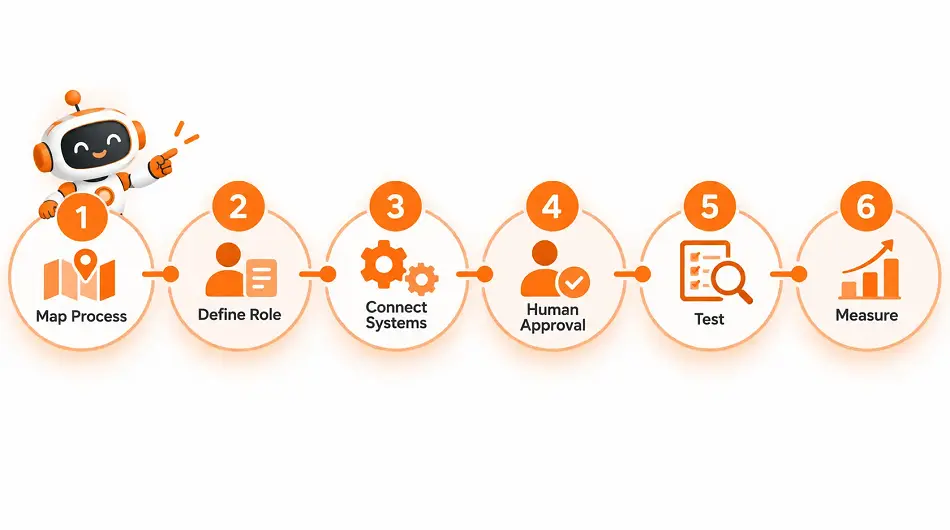
Understanding how to implement AI agents is less about choosing a model and more about designing the business process around it. Ops and IT teams need to work together from the start.
Step 1: Map the Current Process
Document how the work happens today.
List the people involved, systems used, decisions made, exceptions, data sources, and approval points.
This often reveals problems that should be fixed before development starts.
Step 2: Define the Agent’s Role
Decide what the agent can see, decide, and do.
For example, an agent may be allowed to read customer records and prepare a refund request but not approve the refund.
These boundaries should be part of the design.
Step 3: Connect business systems
The agent needs controlled access to the information required for its task.
This may call for AI custom software in Singapore that links existing business systems through secure integrations.
The design should limit access to what the agent needs, as it should also record actions so teams can review what happened.
Step 4: Add Human Approval Points
Not every task should run without review.
Set approval rules based on risk, value, confidence, and business impact.
A low-value update may run without approval. A large payment or sensitive customer decision may require a person.
Step 5: Test Real Business Cases
Testing should cover normal cases and exceptions.
Use examples such as missing information, conflicting records, unusual customer requests, system failures, and incorrect inputs.
The goal is to understand how the agent behaves when the process does not go as planned.
Step 6: Measure Business Results
Track results that matter to the operation.
This could include handling time, cost per case, error rates, backlog size, response time, staff workload, and customer satisfaction.
These measures help teams decide whether to expand the project.
What Should Singapore Businesses Consider Before AI Agent Development?
Good AI agent development depends on governance as much as software.
An agent may have access to customer records, internal documents, financial information, or employee data. This makes security and control part of the core project.
Data Protection
Singapore organisations should consider their duties under local data protection requirements.
Teams need to know what data enters the system, where it goes, who can access it, and how long it remains available.
Sensitive data should receive stronger controls.
Access Management
An agent should not have more system access than it needs.
Use the same principle used for staff accounts: give the minimum access required for the role.
Audit Records
Important actions should create records.
If an agent changes a customer record, triggers a workflow, or prepares a financial action, the business should be able to review what took place.
Clear Ownership
Every agent needs an owner, as someone should be responsible for its performance, permissions, errors, and process changes. Without ownership, small issues can become operating risks.
When Does Custom Development Make Sense?
Some businesses can start with existing automation features while others have processes that need deeper integration or special controls.
This is where custom software can be a better fit.
Complex Internal Processes
Companies often have workflows shaped by years of business rules, system changes, and local operating needs.
A generic system may force the company to change a working process to fit the software.
Custom development can build around the process that creates business value.
Existing System Integration
An agent becomes more useful when it can work with the systems the company already uses.
An AI custom software in Singapore project may focus less on creating a new user interface and more on connecting data, workflows, and approval rules behind the scenes.
Security and Governance Needs
Large companies or regulated firms may need tighter control over access, data storage, logs, and actions.
Custom development gives IT teams more control over how these requirements are built into the system.
What Does a Practical AI Agent Roadmap Look Like?
The strongest approach is to start small, prove value, and expand with control.
First Phase
Choose one process with clear volume and measurable pain. Map it, define boundaries, build the first workflow, and test it with a small group.
Second Phase
Review the results and check where the agent saves time, where people still need to step in, and where errors occur, and improve the workflow before adding more tasks.
Third Phase
Once the design is stable, connect more processes or business teams.
This creates a reusable foundation for future AI agents for business rather than a collection of separate experiments.
Conclusion
Overall, agentic systems are moving business automation from simple rules towards software that can manage parts of a process from start to finish.
For Singapore companies, the strongest use cases are not based on novelty. They are based on real operating problems: staff moving data between systems, repeated checks, slow support queues, manual document work, and processes with too many handovers.
Ops teams understand where the time is lost. IT teams understand the systems, data, security, and controls needed to fix it. Successful projects need both.
The best place to begin is one clear process with a measurable goal. Define what the agent can do. Keep high-risk decisions with people. Test exceptions, not just ideal cases. Track the result in business terms.
With that foundation, agentic AI can become more than a technology experiment. It can form part of a wider operations and custom software strategy that makes daily work simpler, faster, and easier to manage.