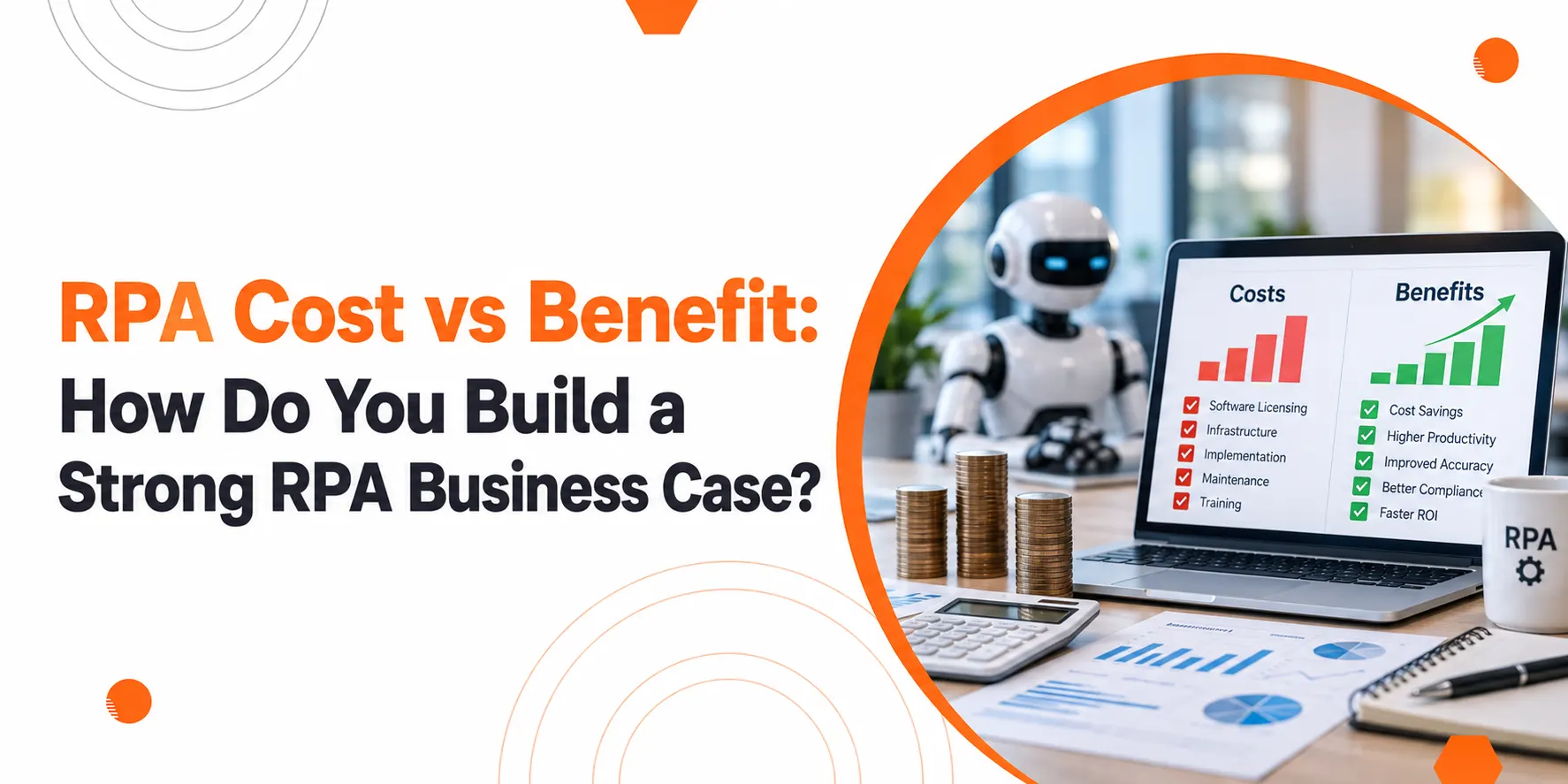
For a CFO or operations leader, automation is not a technology decision alone, but it’s an investment decision. Before approving spend, you need to know what the business will gain, what it will cost, and when the investment will pay back.
A strong RPA business case puts these points into financial terms. It links automation to labour savings, capacity, error reduction, service quality and business growth. It also includes the full cost of implementation, support and change.
The goal is not to prove that automation is useful but to show where it creates measurable value.
This guide explains how to build a business case for RPA, run an RPA cost-benefit analysis, and present the findings in a format that finance and operations teams can support.
Build Custom Software That Fits Your Business
From CRM to inventory systems — we design solutions around your workflow, not the other way around.
What Should an RPA Business Case Prove?
An RPA business case should prove that the expected business value is greater than the total cost and risk of the investment.
Decision-makers need more than a list of tasks that can be automated. They need evidence that the proposed automation supports a business goal and delivers a return within an acceptable period.
A Clear Business Problem
Start with the problem, not the automation.
For example, an accounts payable team may spend hundreds of hours each month moving invoice data between systems. A customer service team may have staff copying information from emails into internal records.
Define the current issue in business terms:
- How many hours does the process consume?
- How much does it cost?
- How many transactions are handled?
- How often do errors occur?
- What delays does the process create?
- Does demand change during peak periods?
This gives you a baseline against which you can measure the result.
A Measurable Outcome
Next, state what success means.
A useful target could be reducing manual processing hours by 50%, cutting the cost per transaction, or increasing capacity without adding headcount.
The strongest targets connect to numbers that finance teams can verify.
What Costs Should You Include Before Investing in RPA?
Your cost model should include implementation, software, process design, testing, training, maintenance, and internal staff time.
Leaving out indirect costs can make an automation project look stronger on paper than it will be in practice.
Initial Implementation Costs
Implementation may include process assessment, workflow design, configuration, integration, and testing.
Complex processes tend to cost more. A task that follows stable rules across one or two systems will often need less work than a process with many exceptions and systems.
When assessing RPA cost, companies should also consider local labour costs, the size of the automation programme and the complexity of their existing systems.
Ongoing Operating Costs
Automation has running costs after launch.
Your model may need to cover licences, infrastructure, monitoring, maintenance, support and updates when business systems change.
If an application or process changes, the automation may need changes too.
Internal Resource Costs
Internal staff time has a cost even when it does not appear on a supplier invoice. Process owners may need to document workflows.
IT teams may support security and access requirements while finance teams may help validate assumptions and savings.
Include these hours in the investment model.
Change and Training Costs
Employees need to understand how their work will change.
Some teams may move from data entry towards exception handling, review, and customer support. Training and process changes should form part of the cost estimate.
A complete cost model gives decision-makers a more credible view of the investment.
Which RPA Benefits Should CFOs Measure?
CFOs should measure labour capacity, cost reduction, error reduction, processing speed, compliance, and the financial value of increased capacity.
Some are direct and easy to calculate. Others improve business performance without appearing as an immediate cash saving.
Labour Capacity
Suppose a process takes 1,000 employee hours each month. Automation removes 600 hours of repetitive work.
That does not mean the company saves the full salary cost of 600 hours.
The business may use that capacity for other work instead of reducing headcount. Your case should state whether the value comes from cash savings, avoided hiring, or staff capacity.
This distinction makes the numbers easier to defend.
Lower Error Costs
Manual data entry can create errors. Those errors may lead to rework, customer complaints, payment problems, or reporting issues.
Estimate the current cost of correcting mistakes. Then calculate how much that cost could fall after automation.
This can turn an operational improvement into a financial measure.
Faster Processing
Speed can have financial value.
Faster invoice processing may help a business capture early-payment discounts. Faster customer onboarding may allow revenue to start sooner. Faster order processing can improve service levels.
Where possible, link time savings to money.
Greater Processing Capacity
A business that is growing may need more staff to handle higher transaction volumes.
Automation can help existing teams process more work without matching every rise in demand with new hires.
These RPA benefits can be important in companies with seasonal demand or rapid growth.
How Do You Conduct an RPA Cost-Benefit Analysis?
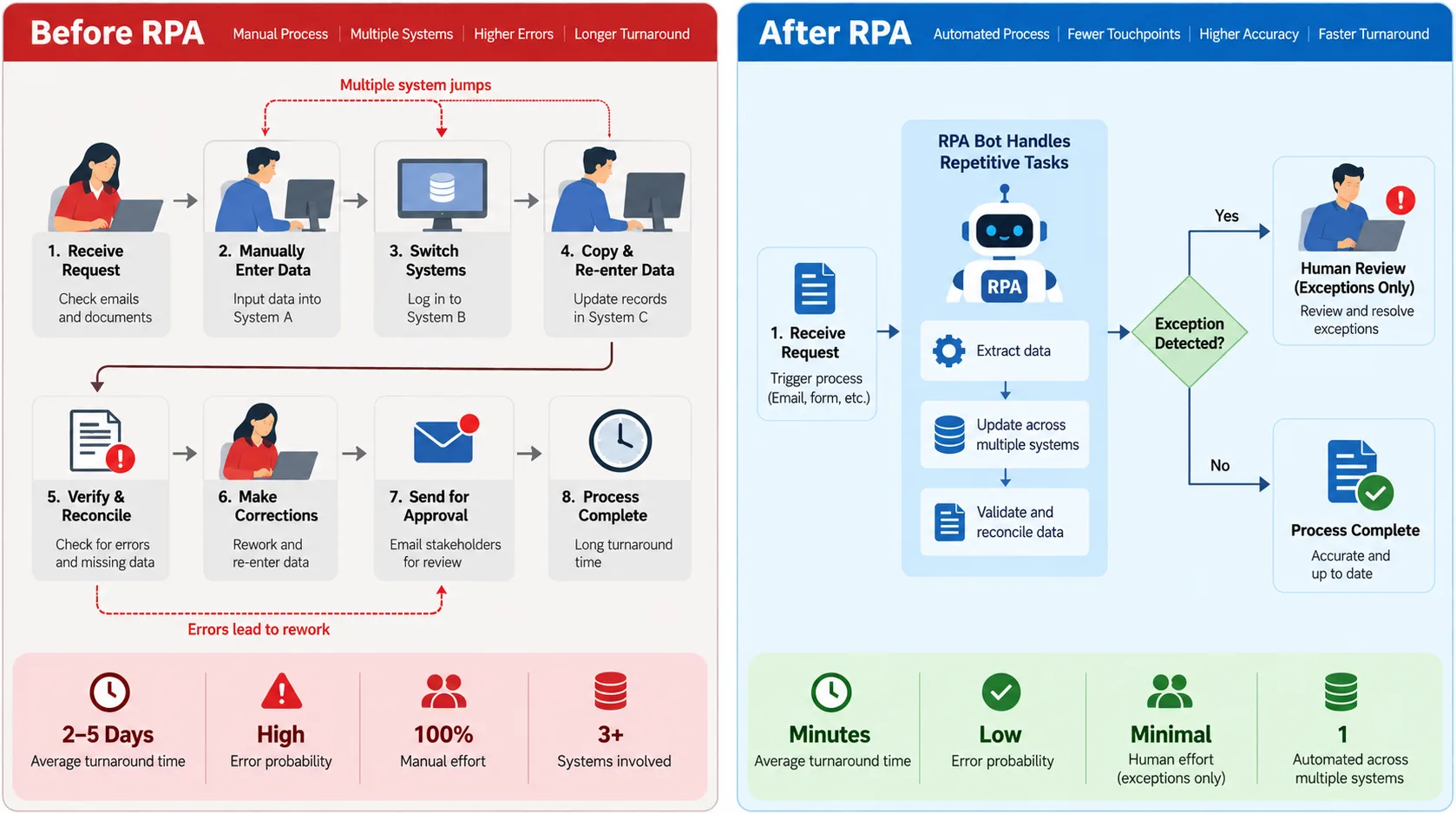
An RPA cost-benefit analysis compares the full investment with measurable savings and business value over a defined period.
A three-year view is often useful because it shows both initial costs and recurring benefits.
Establish the Current Baseline
First, calculate the cost of the process today.
For example:
Annual transaction volume: 120,000
Average handling time: 5 minutes
Total processing time: 10,000 hours
Average loaded labour cost: S$25 per hour
Annual labour cost: S$250,000
You can then add the cost of errors, overtime, or extra staff required during peak periods.
Estimate the Future State
Assume automation can handle 60% of the workload.
That would remove 6,000 manual hours from the process. At S$25 per hour, the gross value of that capacity is S$150,000 per year.
If the business also saves S$20,000 in rework and avoids S$30,000 in planned hiring, the total annual benefit could reach S$200,000.
Do not count the same saving twice. If avoided hiring already represents the value of saved employee hours, keep those figures separate.
Calculate the Total Investment
Assume the project has:
Year-one implementation and setup: S$70,000
Year-one operating costs: S$30,000
Annual operating costs after year one: S$35,000
The first-year cost is S$100,000.
If measurable first-year benefits reach S$200,000, the project generates S$100,000 of net value before other financial adjustments.
This simple RPA cost-benefit analysis gives finance leaders a base for comparing the project with other investment options.
Measure Payback and ROI
Two measures can make the case easier to understand.
Payback period shows how long it takes for benefits to recover the initial investment.
ROI compares net benefits with investment cost.
A simple formula is:
ROI = (Total Benefits − Total Costs) ÷ Total Costs × 100
Use the same time period for costs and benefits. State all assumptions so reviewers can test the numbers.
How Can You Build a Business Case for RPA That Finance Will Trust?
Build it around verified process data, conservative assumptions, transparent costs, and outcomes that connect to business priorities.
If you are working out how to build a business case for RPA, avoid starting with a large automation target. Start with a process where the numbers are clear.
Use Conservative Assumptions
Do not assume that every manual hour removed becomes a cash saving.
Separate benefits into categories such as:
- Direct cost savings
- Cost avoidance
- Capacity released
- Revenue impact
- Risk reduction
This helps a CFO understand which benefits affect cash flow and which improve operations.
Show Best, Expected, and Downside Cases
A single forecast can hide uncertainty.
Create three cases. A downside case may assume lower automation rates and higher implementation costs. The expected case can use the most supported assumptions. A best case can show the upside if adoption and performance exceed the base plan.
This approach gives decision-makers a view of the risk range.
Define Ownership
Every expected benefit should have an owner.
If operations expects 5,000 hours of released capacity, someone should be responsible for tracking how that capacity is used.
Without ownership, projected savings can disappear after implementation.
Why Can RPA Benefits for SMEs Be Different?
RPA benefits for SMEs can centre on capacity, growth and reducing dependence on repetitive manual work rather than large-scale headcount savings.
Smaller companies may have fewer transactions, but each employee can cover several processes. Releasing even part of a person’s working week can have value.
Growth Without Matching Headcount Increases
An SME processing 5,000 orders per month may expect volume to rise to 8,000.
Without automation, that growth could require more staff. With the right RPA solutions, the company may handle part of the increase with its existing team.
The value comes from avoided recruitment and stronger operating capacity.
Better Use of Skilled Staff
Finance and operations employees often spend time copying data, checking records and preparing routine reports.
One of the main RPA benefits for SMEs is the ability to move staff time towards analysis, customer work and exception handling.
This can help a smaller team support more work without creating the same level of administrative pressure.
How Does RPA in Singapore Affect the Business Case?
RPA in Singapore can be assessed against local labour costs, business growth plans, compliance needs, and the cost of operating automation over time.
Companies should avoid using a generic international ROI model without adjusting it to their own cost base.
Local Cost Assumptions
The business case should use actual salary and employment costs for the teams involved.
When estimating RPA cost in Singapore, include implementation, internal resources, ongoing support, and any costs linked to system changes.
This gives management a more useful figure than a headline project price.
Process Selection
The economics of RPA in Singapore depend on choosing the right processes.
High-volume, repetitive, and rules-based work can make strong candidates. Processes with frequent exceptions or unstable steps may offer weaker returns.
Companies assessing RPA solutions should focus on business outcomes rather than the number of processes they can automate.
What Risks Should Be Included in the RPA Business Case?
Your RPA business case should include process change, system change, poor data quality, security, maintenance, and adoption risks.
Ignoring risk can produce an attractive ROI figure that fails to reflect what could happen after launch.
Process Stability
A process that changes every few weeks can require more maintenance.
Check whether the workflow is stable before making long-term savings assumptions.
System Dependencies
If automation relies on several applications, a change to one system may affect the workflow.
Estimate the support needed to manage these changes.
Benefit Leakage
Released employee time does not create value unless the business uses it.
If automation saves 20 hours per week but those hours have no planned use, the financial benefit may be limited.
Link released capacity to clear outcomes such as higher volume, avoided hiring, or work that had been delayed.
What Should Your Final Investment Proposal Include?
Your final proposal should give decision-makers enough information to approve, reject, or revise the investment without searching through technical detail.
Keep the main document focused on business value.
Executive Summary
State the problem, proposed investment, expected annual benefit, ROI, payback period, and major risks.
Financial Model
Show current costs, expected future costs, implementation spend, recurring spend, and benefits over the chosen period.
Make every major assumption visible.
Delivery Scope
Define which processes are included, what is excluded, and which teams will be affected.
Success Measures
Set targets for cost, time, errors, capacity, and service levels.
These measures will help the business check whether the investment delivers what was promised.
Conclusion
Overall, RPA can be worth the investment when it solves a measurable operational problem and produces enough value to justify its full cost and risk.
The strongest case is not the one with the largest projected savings. It is the one that management can verify.
Start with a clear baseline. Include every material cost. Separate hard savings from capacity gains. Test downside scenarios. Give each benefit an owner.
For CFOs and operations leaders, this turns automation from a technology proposal into an investment decision.
That is the purpose of a strong RPA business case: to show where the money goes, what the business gets back, and whether the return is strong enough to justify action.