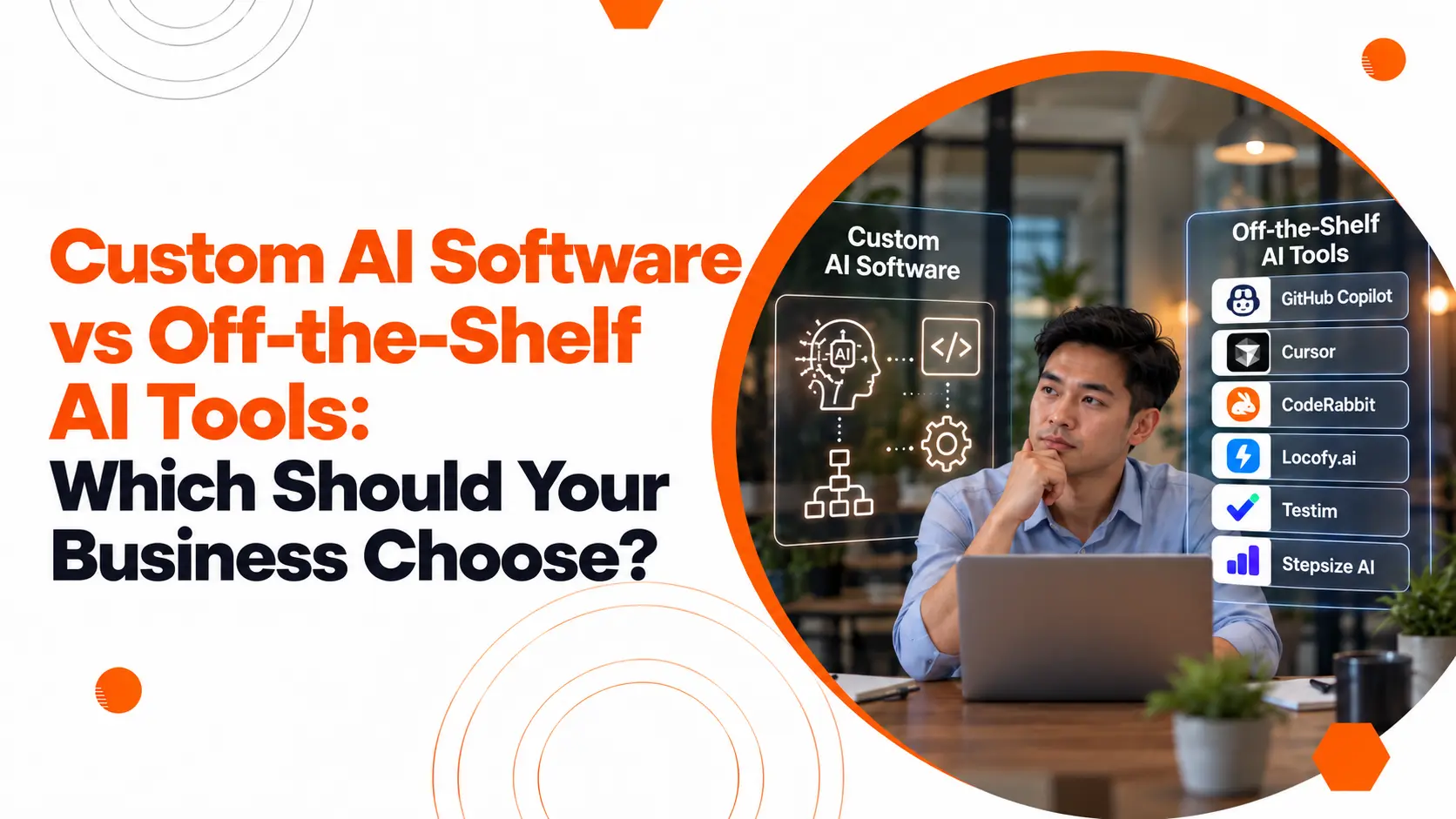
CTOs and founders need to select between developing custom AI software and using ready-made AI solutions which helps them to make this important decision. Businesses can quickly implement AI through ready-made tools, but they gain access to customised solutions that provide enhanced adaptability, better integration capabilities, and they can manage their specific operational processes.
Your business needs will determine which solution suits you best, as you need to achieve your goals with technical requirements, budget constraints, data security needs, and expansion plans.
The different AI systems require people to understand the difference between custom AI vs off-the-shelf as this knowledge prevents unnecessary development expenses while organisations can spend money on AI solutions that generate measurable business benefits.
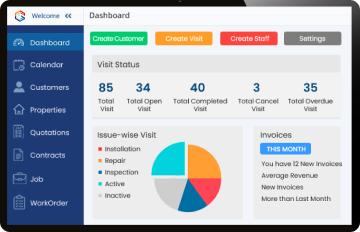
Build Custom Software That Fits Your Business
From CRM to inventory systems — we design solutions around your workflow, not the other way around.
What Is Custom AI Software?
Custom AI software operates as an AI-driven application that developers create to support particular business processes, handle data needs, and achieve organisational objectives.
Custom AI solutions address problems that generic tools fail to solve effectively, as they differ from ready-made products. The systems allow businesses to connect their current systems while performing particular work and making choices based on automated processes.
For example, A logistics company can use custom AI solutions to predict delivery delays by combining their historical delivery data with weather information and route data. The solutions operate through large language models (LLMs), machine learning systems, retrieval-augmented generation (RAG), and AI agents, which provide specific features without requiring users to develop their own AI models.
What Are Off-the-Shelf AI Tools?
Off-the-shelf AI tools are pre-built software products that businesses can purchase or subscribe to and use with minimal development.
Several industries use these tools as they solve common business problems that appear in various market sectors. They include AI writing assistants, meeting transcription software, customer support chatbots, and AI-driven productivity platforms.
For example, the marketing team depends on AI writing assistants to create content, but the sales team uses AI-enabled CRM systems that create customer interaction summaries and perform automated follow-up tasks.
Businesses need to adopt off-the-shelf solutions when they want to deploy AI systems quickly without needing software development teams or complicated system management.
Custom AI vs Off-the-Shelf: Key Differences
Off-the-shelf AI tools prioritise speed and convenience, while custom AI software prioritises specialised functionality, integration, and control.
| Factor | Custom AI software | Off-the-shelf AI tools |
| Initial investment | Generally higher | Generally lower |
| Implementation | Weeks to months, depending on scope | Often days or weeks |
| Customisation | Designed around specific requirements | Limited to available features |
| Integration | Can connect deeply with internal systems | Depends on supported connectors |
| Data control | Can be designed around specific governance needs | Depends on vendor policies |
| Maintenance | Requires ongoing technical support | Mostly managed by the provider |
| Scalability | Can be tailored to business requirements | Depends on plans and usage limits |
| Competitive advantage | Can support proprietary workflows | Offers capabilities available to other customers |
The key distinction between custom AI vs. off-the-shelf is not only about cost. It is whether the solution fits the business problem well enough to justify its total cost of ownership.
When Should You Choose Off-the-Shelf AI Tools?
Select off-the-shelf AI solutions when your company needs standard solutions with fast deployment and no need for extensive customisation. Consider them in the following situations:
1. Your Requirements Are Standard
Current AI systems generate content, create meeting summaries, provide customer support, and perform content translation tasks.
2. You Need Quick Results
Subscription-based tools allow teams to implement AI quickly without waiting for lengthy development.
3. Your Budget Is Limited
The initial costs for off-the-shelf solutions tend to be lower than what businesses need to pay for custom AI development.
4. Your Integrations Are Already Supported
The current system connects AI tools with CRM software, project management systems, and communication platforms through its existing integrations.
5. You Are Validating a Business Idea
Startups need to check market demand before they spend money on building their own software.
When to Build Custom AI Software
Build custom AI software when standard solutions fail to fulfill your business requirements for custom workflows, unique data handling, and system management and integration needs.
The solution depends on custom development because AI systems produce operational efficiency gains with improved customer service and better market position for businesses. Let’s understand when to build custom AI in more depth:
1. Unique Business Workflows
Your business needs specialised processes or decision rules that generic tools cannot support.
2. Proprietary Data
Your business will succeed from AI adoption because of the data which exists already within your organisation.
3. Complex Integrations
Your system solution needs to connect various internal systems while organising workflow operations through automated system responses.
4. Specific Accuracy Requirements
Your business requires outputs tailored to domain-specific standards and evaluation criteria.
5. Security and Governance Needs
The system needs three particular security components, which consist of access control systems, data storage guidelines, and monitoring infrastructure.
Cost Comparison: Custom AI vs SaaS AI Tools
Off-the-shelf AI tools generally have lower upfront costs, while custom AI requires greater initial investment and ongoing maintenance. Let’s understand the cost comparison between custom AI vs saas ai tools
Off-the-Shelf AI Costs
Users have three pricing options to choose from when they want to access ready-made tools: subscription fees, per-user charges, and usage-based pricing models. The adoption process becomes easier for these solutions as they provide simple budgeting options that work well when businesses have clear requirements.
Custom AI Development Costs
The development of custom solutions requires financial resources to support all phases from initial planning through development and testing, system integration and cloud infrastructure operation, AI model operation, and ongoing maintenance needs. The total expenses for security projects depend on how complex the project is, what data conditions exist, and what security protection levels need to be established
Which Option Is More Cost-Effective?
Determine the total cost of ownership over three to five years instead of concentrating on the initial payment. Multiple subscriptions can become expensive as usage grows, while custom software development introduces infrastructure and maintenance costs.
Neither option is automatically cheaper long-term. Businesses should evaluate projected costs against measurable returns. Explore our guide to AI development costs in Singapore to understand the factors influencing project budgets.
Real-World Examples: Which Approach Fits Your Business?
Businesses need to choose AI systems for their operations based on how complex each task is and which functions hold strategic value instead of using a single approach throughout their entire organisation.
1. D2C brand
The existing AI writing tool meets the needs for generating product descriptions and social media captions. The system needs a custom recommendation engine as it requires analysis of unique customer behaviour with stock database connectivity.
2. SaaS startup
A ready-made coding assistant can improve developer productivity. The product demands a custom AI feature that its developers must create to achieve market differentiation through customer value delivery.
3. Small agency
Off-the-shelf AI can support content creation, transcription, and routine administration. The execution of custom workflow automation becomes essential when repeated work requires users to access two or more client platforms and complete multiple approval steps within their organisation.
4. Enterprise organisation
The existing AI platforms handle standard productivity requirements, but custom-built systems perform specialised analytics operations and support internal knowledge retrieval and complex operational workflow management.
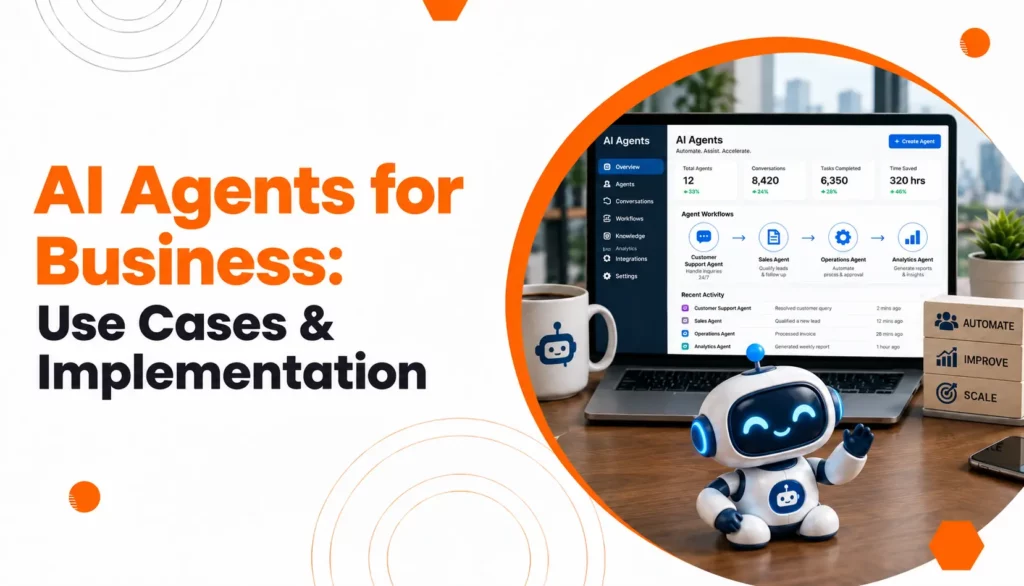
Businesses can also explore AI agent use cases to identify processes where AI can retrieve information, make decisions within defined limits, and perform approved actions.
Final Thoughts
Overall, Businesses should purchase ready-made AI systems for their basic needs, while they must obtain custom AI systems for their approved business requirements that need advanced control systems, unique system connections, and distinct operational approaches.
The choice between custom AI vs. off-the-shelf solutions should focus on business outcomes instead of following the assumption that building AI systems always leads to advanced solutions or that buying solutions always saves money.
At Genic Solutions, we help businesses develop AI solutions tailored to their operational needs and growth objectives, so visit us now