Automation has changed how businesses handle everyday work. What started with simple scripts and fixed workflows has grown into systems that can process information, make decisions, and manage multi-step tasks.
For CTOs and IT leaders, this growth creates a new question: which approach fits which problem?
The RPA vs AI discussion is no longer about choosing one technology for every task. RPA, AI-based automation, and agentic automation solve different types of problems. Each has its own role, strengths, limits, and business value.
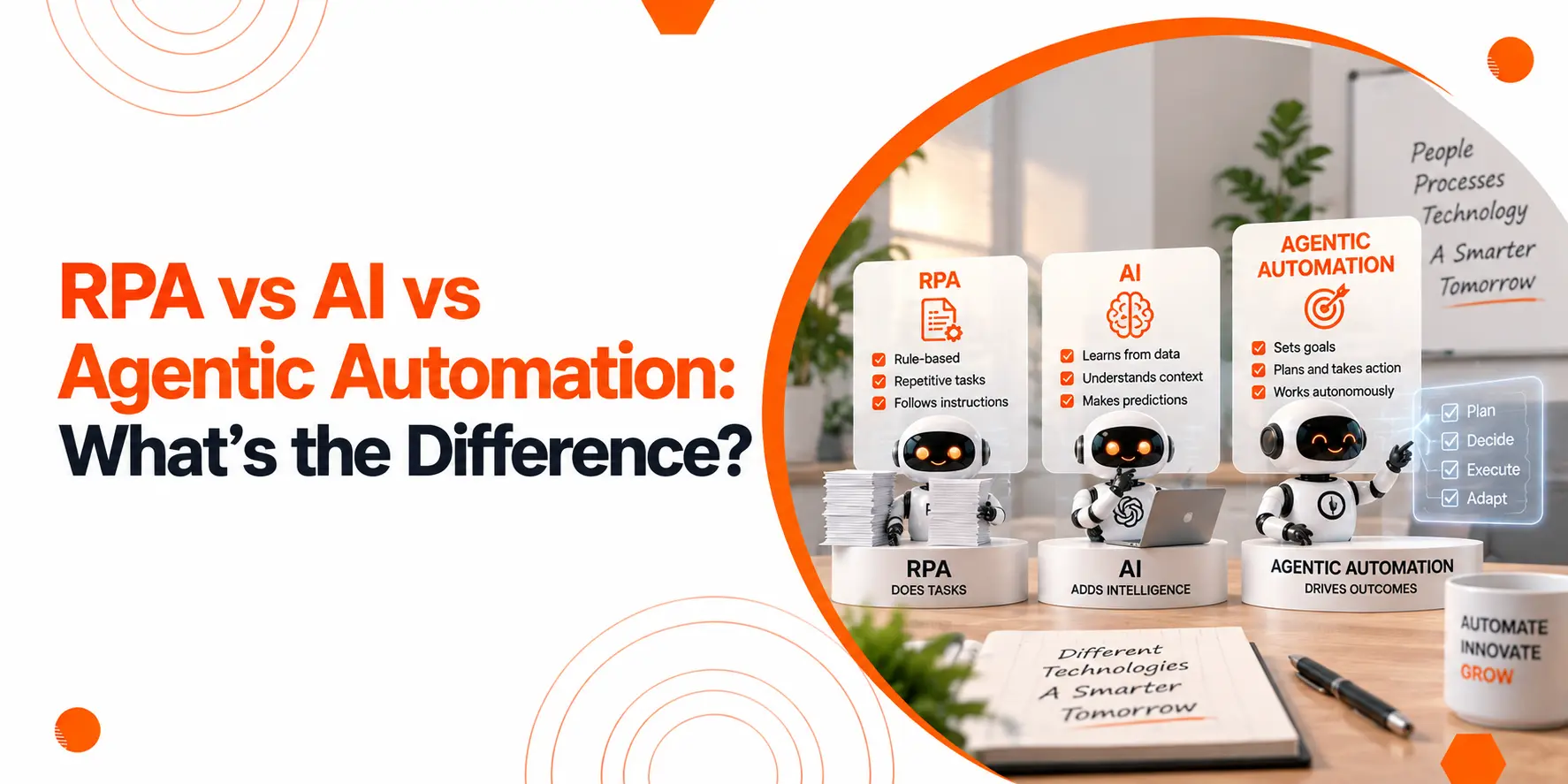
RPA works well when tasks follow clear rules. AI-based systems are useful when work involves data, language, patterns, or judgement. Agentic automation goes a step further by working towards a goal and deciding which actions should happen next.
Understanding these differences can help IT teams invest in the right type of automation instead of forcing every process into the same model.
This guide explains the RPA vs AI automation comparison, where agentic automation fits, and how CTOs can choose between them.
Build Custom Software That Fits Your Business
From CRM to inventory systems — we design solutions around your workflow, not the other way around.
What Is RPA and How Does It Work?
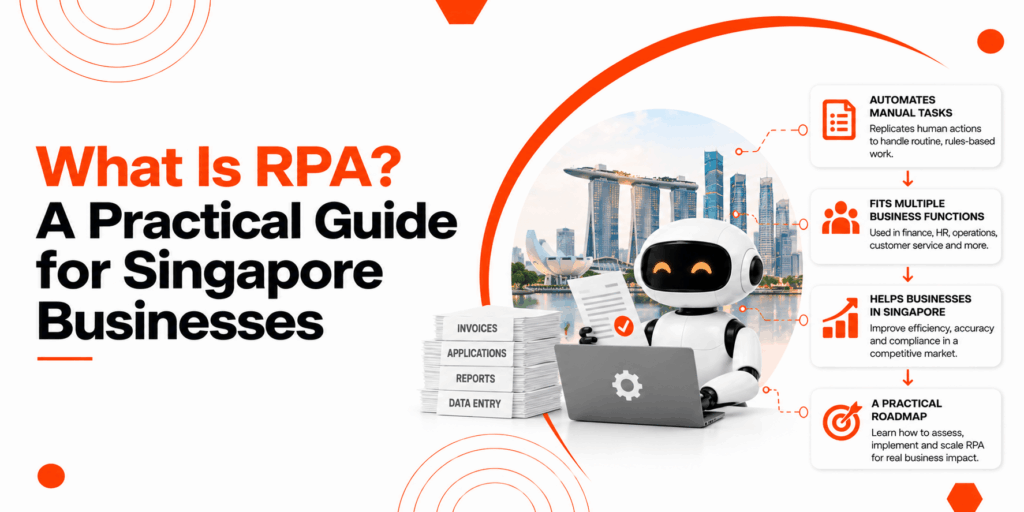
Robotic Process Automation, or RPA, uses software to carry out repetitive digital tasks based on predefined rules.
Think of it as a digital worker that follows a clear set of instructions. It can open applications, enter data, move files, copy information between systems, create reports, and complete other structured actions.
If the process can be written as a stable sequence of steps, RPA may be a good fit.
Rule-Based Execution
The main feature of RPA is predictability.
A workflow may say:
- Open a file.
- Read a specific field.
- Enter the value into another system.
- Save the record.
- Send a notification.
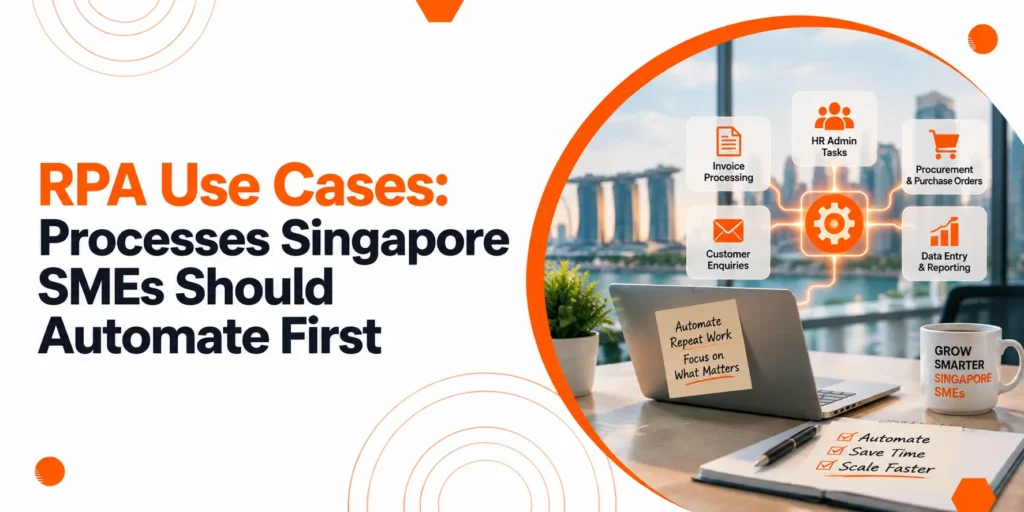
The software follows those instructions as it does not need to understand why the process exists. Common RPA use cases include invoice processing, data entry, report generation, employee onboarding, order updates, account reconciliation, and moving information between older business systems.
For organisations exploring RPA solutions or automation programmes in other markets, this rule-based model often provides a practical starting point.
A deeper guide on what is RPA can help teams identify processes that fit this approach before they begin implementation.
What Is AI-Based Automation and How Is It Different From RPA?
The core difference between RPA and AI comes down to rules versus interpretation.
RPA follows instructions. AI-based automation can work with information that does not fit a fixed structure.
For example, an RPA workflow can move an invoice from one system to another when every field appears in a known location. An AI-based system can help identify information when invoices arrive in different layouts or formats.
This ability expands the range of work that organisations can automate.
Data Understanding and Decision Support
AI-based automation can support tasks involving documents, text, images, patterns, classification, forecasting, and recommendations.
Consider a customer service process.
RPA in Singapore might take information from a form and enter it into a business system. An AI-based component could identify the subject of a customer message and route it to the right team.
This combination is often called intelligent automation.
It brings structured execution and information processing into the same workflow.
The goal is not to replace RPA. It is to handle parts of a process that fixed rules struggle to manage.
How Does the RPA vs AI Automation Comparison Work?
A useful RPA vs AI automation comparison starts with the nature of the task. RPA works best with predictable processes. AI-based automation works better when the input changes and the system needs to interpret it. Here is a simple comparison:
| Area | RPA | AI-Based Automation |
| Main approach | Follows fixed rules | Interprets data and patterns |
| Best input | Structured | Structured and unstructured |
| Decision model | Predefined | Data-driven |
| Process flexibility | Limited | Higher |
| Best suited for | Repetitive tasks | Complex information tasks |
| Human judgement support | Low | Higher |
| Process changes | Often needs workflow updates | Can handle more variation |
| Main value | Speed and consistency | Understanding and decision support |
Neither approach is better in every situation, as the right choice depends on the process.
If you need to copy values between two stable systems, adding complex decision technology may create cost without much benefit. If you need to interpret thousands of different customer messages, fixed rules may become hard to maintain.
That distinction should guide architecture decisions.
What Is Agentic Automation and Where Does It Fit?
Agentic automation introduces a different way to think about work. Instead of giving software every step, you give it a goal, boundaries, access to approved systems, and rules for what it can or cannot do.
The system can then determine which steps are needed to reach that goal. This is where agentic AI differs from traditional workflow automation.
Goal-Based Execution
“Prepare the monthly Imagine a task such as: operations review.”
A standard RPA process would need each action defined in advance.
An agentic system could break the goal into smaller tasks. It may gather approved data, check whether information is missing, organise the findings, prepare a summary, and send the result for human review.
The workflow is less dependent on one fixed sequence what makes agentic automation useful for processes where the path can change, but the end goal stays clear.
It also creates new requirements around security, permissions, monitoring, testing, and human control.
How Is Agentic AI vs RPA Explained in Simple Terms?
For anyone looking for agentic AI vs RPA explained without technical jargon, the difference can be summarised through instructions.
RPA says: “Follow these steps.”
AI-based automation says: “Understand this information and help choose the right action.”
Agentic automation says: “Reach this goal within these rules.”
That difference matters.
An RPA workflow depends on a defined path. An agentic workflow may select a path based on the situation it encounters.
For example, consider an IT support request.
RPA could create a ticket, copy details into another system, and send an acknowledgement.
AI-based automation could classify the request and identify its likely category.
Agentic automation could assess the request, gather relevant context, choose an approved resolution path, complete permitted actions, and escalate the case when human approval is required.
The three approaches can also work together, and they do not have to compete.
When Should You Use RPA vs AI?
The question of when to use RPA vs AI should start with process design, not technology.
CTOs should look at the inputs, rules, exceptions, risks, systems, and expected outcomes.
Choose RPA for Stable Processes
RPA makes sense when a task has clear rules, structured inputs, high volume, and limited exceptions.
Good candidates include transferring records, updating fields, generating standard reports, checking known conditions, and completing routine administrative work.
RPA can also help connect older systems where direct integration is costly or unavailable.
Choose AI-based Automation for Variable Information
AI-based automation is more suitable when the process needs to work with changing inputs.
This may include document classification, extracting information from varied files, understanding customer requests, detecting patterns, or supporting decisions.
The business case becomes stronger when human teams spend large amounts of time reading, sorting, reviewing, or interpreting information.
Choose Agentic Automation for Goal-Driven Work
Agentic automation may fit when a task includes several steps and the correct sequence can change.
It is suited to work where the system must choose between approved actions, respond to changing conditions, and coordinate different parts of a process.
Strong controls are important. Businesses need clear permissions, action limits, audit trails, review points, and escalation paths.
How Do RPA, AI, and Agentic Automation Work Together?
The strongest automation strategy may involve all three approaches. Instead of relying on one method, businesses can use each one for the work it handles best.
A Connected Automation Process
Consider an insurance claims process.
RPA can collect information from structured systems. An AI-based component can process documents and identify important details. An agentic layer can then decide what needs to happen next based on the claim, business rules, available information, and defined permissions.
RPA can then carry out routine updates across different systems.
A Practical Intelligent Automation Model
This creates intelligent automation without forcing one technology to solve every part of a process. Each approach has a clear role within the wider workflow.
The same model can apply to finance, HR, customer service, IT operations, supply chains, healthcare administration, and other business functions.
The key is to divide each process based on the type of work being performed and use the right automation approach for each task.
What Are the Main Benefits and Limitations of Each Approach?
Every automation model involves trade-offs. Understanding the strengths and limits of each approach helps IT teams choose the right option for each business process.
RPA for Structured Tasks
RPA can reduce repetitive manual work and improve consistency. It can also make auditing easier because its actions follow defined rules. However, RPA can become harder to manage when processes change often or involve many exceptions.
AI-Based Automation for Complex Information
AI-based automation can process complex information and support business decisions. It works well when tasks involve varied data or require interpretation. However, its outputs may need stronger validation, data controls, and human review.
Agentic Automation for Broader Goals
Agentic automation can manage broader goals and changing workflows. This flexibility also creates greater governance needs.
IT teams must define what an agent can access, which actions it can perform, when it must stop, and when a person must approve the next step. The more freedom a system has to act, the more important these controls become.
What Should CTOs Consider Before Investing in Automation?
Technology selection should come after process assessment. So, start by asking what problem the organisation wants to solve.
A process that is broken, unclear, or full of unnecessary steps should not be automated without review.
Process Maturity
Stable processes are easier to automate. If teams follow different versions of the same workflow, standardisation may need to happen first.
System Integration
Automation often crosses several applications.
Some organisations may need integration work or software development services to connect systems, build secure interfaces, or support workflows that existing applications cannot handle.
Data Quality
Poor data can limit any automation project.
Incorrect records, missing fields, duplicate information, and inconsistent formats can lead to weak results.
Security and Governance
Access should follow the principle of least privilege.
Each automated process should have only the permissions required to perform its job. Logs, approval steps, exception handling, and monitoring should form part of the design.
These controls become more important as automation gains greater decision-making freedom.
How Can Businesses Build a Practical Automation Roadmap?
A good roadmap does not begin with the most complex technology available.
It begins with business value.
Map processes across the organisation and identify repetitive work, decision points, delays, exceptions, manual hand-offs, and high-cost activities, then classify each part of the process.
Use RPA where rules are fixed, so use intelligent automation where information needs interpretation. Consider agentic automation where the workflow requires goal-based decisions across several steps.
Start with controlled projects that have measurable outcomes.
Track factors such as processing time, error rates, manual effort, exception rates, operating cost, and user experience to create evidence for future investment.
It also prevents organisations from turning automation into a technology project with no clear business result.
Will Agentic Automation Replace RPA?
RPA is unlikely to disappear just because more flexible forms of automation exist.
Many business tasks are still repetitive and rule-based. There is little reason to replace a simple, reliable workflow with a more complex system when the process does not require it, as agentic automation changes where RPA fits.
RPA can become one execution layer within a broader automation environment. An agentic system may decide what needs to happen, while a rule-based workflow carries out a predictable action; this creates a layered model.
The future of enterprise automation may involve fewer arguments about RPA vs AI and more focus on how different approaches can work together.
What Is the Key Difference Between RPA, AI and Agentic Automation?
People can understand the differences between these concepts when they visualize them as steps that need to be followed to achieve particular goals. The three approaches operate differently when they manage work activities through their unique systems, which work best for particular business requirements.
Steps, Understanding and Goals
The RPA system performs its work by following established instructions which enable it to perform repetitive work activities.
The AI system functions through automated processes which handle data for pattern recognition and decision-making support.
The system known as agentic automation works to achieve its specified target through its ability to select different approved actions that lead to goal achievement.
CTOs together with IT leaders must understand this difference because automation now exists as multiple distinct categories instead of its previous single-category system. The three methods need distinct amounts of management control, system combination, and strategic preparation.
Matching Automation to the Work
A simple data-entry task requires a different architectural design than document analysis systems. The system needs different control systems because it operates differently from automated systems that select the following action.
The best approach starts with the work itself.
The process needs evaluation for its regularity of operations, its data handling approach, its need for human decision-making, its frequency of unusual cases, and its desired system autonomy level.
The evaluation process between RPA and AI automation systems becomes more obvious because of these established criteria.
Building the Right Automation Mix
RPA remains valuable because it handles structured, repetitive work activities. Intelligent automation enables businesses to increase their automation capabilities because it processes information that does not follow strict pattern rules. Agentic automation builds upon this model through its ability to perform goal-based operations that require multiple sequential actions.
Technology leaders need to avoid choosing a single method because they must understand all available options. The system needs an automation architecture that assigns each method to its appropriate tasks.
Conclusion
Overall, the RPA vs AI decision is not about finding one technology that can automate everything. It is about matching the right approach to the type of work your organisation needs to improve.
RPA remains a practical choice for repetitive, rule-based processes where steps and inputs are predictable. AI-based automation extends those capabilities by interpreting documents, language, patterns, and other forms of structured and unstructured information. Agentic AI takes automation further by working toward defined goals, selecting appropriate actions, and adapting its path within established boundaries.
For CTOs and IT leaders, the most effective strategy may be to combine these technologies rather than treat them as competing alternatives. RPA can handle reliable execution, intelligent automation can support interpretation and decision-making, and agentic automation can coordinate more dynamic, multi-step workflows.
Before investing, businesses should assess process stability, data quality, integration requirements, security risks, exception rates, and the level of autonomy each workflow requires. Starting with clearly defined business problems and measurable outcomes can also help avoid unnecessary complexity.
As enterprise automation continues to evolve, the key question will increasingly shift from RPA vs AI to how RPA, AI, and agentic automation can work together. Organisations that build the right automation mix can create systems that are not only faster and more efficient, but also better suited to the complexity of modern business operations.