
Running an SME in Singapore often means doing more with a lean team. Staff handle customer requests, invoices, payroll records, reports, data entry, and many other routine tasks. These jobs matter, but they can take hours away from work that needs human judgement. That’s where Robotic Process Automation (RPA) can help.
RPA handles repetitive, rule-based digital tasks by following a defined set of steps. It can move information between systems, check records, prepare reports, and process routine transactions. The goal is not to replace every manual task. It is to remove repetitive work that slows teams down.
For operations managers, the key question is where to start.
In this guide, we will cover 12 practical RPA use cases for Singapore SMEs by explaining which processes tend to offer the strongest starting point and how to choose automation projects that solve real operational problems.
Build Custom Software That Fits Your Business
From CRM to inventory systems — we design solutions around your workflow, not the other way around.
What Makes a Process Suitable for RPA?
Not every business process should be automated, as RPA works best when the process has clear rules and predictable steps.
A good candidate often involves high transaction volumes, repeated data entry, or information moving between systems. It may also consume many staff hours or create errors when handled by hand.
Think about a staff member who downloads an invoice, reads several fields, enters them into another system, and saves a copy in the right folder. If this happens hundreds of times each month and follows the same steps, it could be a strong automation candidate.
Understanding what is RPA and what it can handle helps operations teams avoid automating the wrong processes.
Signs Of A Strong Automation Candidate
Look for processes that:
- Follow clear and stable rules
- Take place on digital systems
- Repeat often
- Use structured data
- Require staff to copy or move information
- Have high transaction volumes
- Create bottlenecks during busy periods
- Produce frequent manual errors
The best processes to automate with RPA are often boring by design. They are predictable, repetitive, and necessary, which makes them a good place to begin.
Which Finance Processes Should SMEs Automate First?
Finance departments contain some of the clearest RPA use cases because many tasks follow fixed rules. Finance staff often work across invoices, spreadsheets, internal systems, and bank records.
This creates plenty of repetitive work.
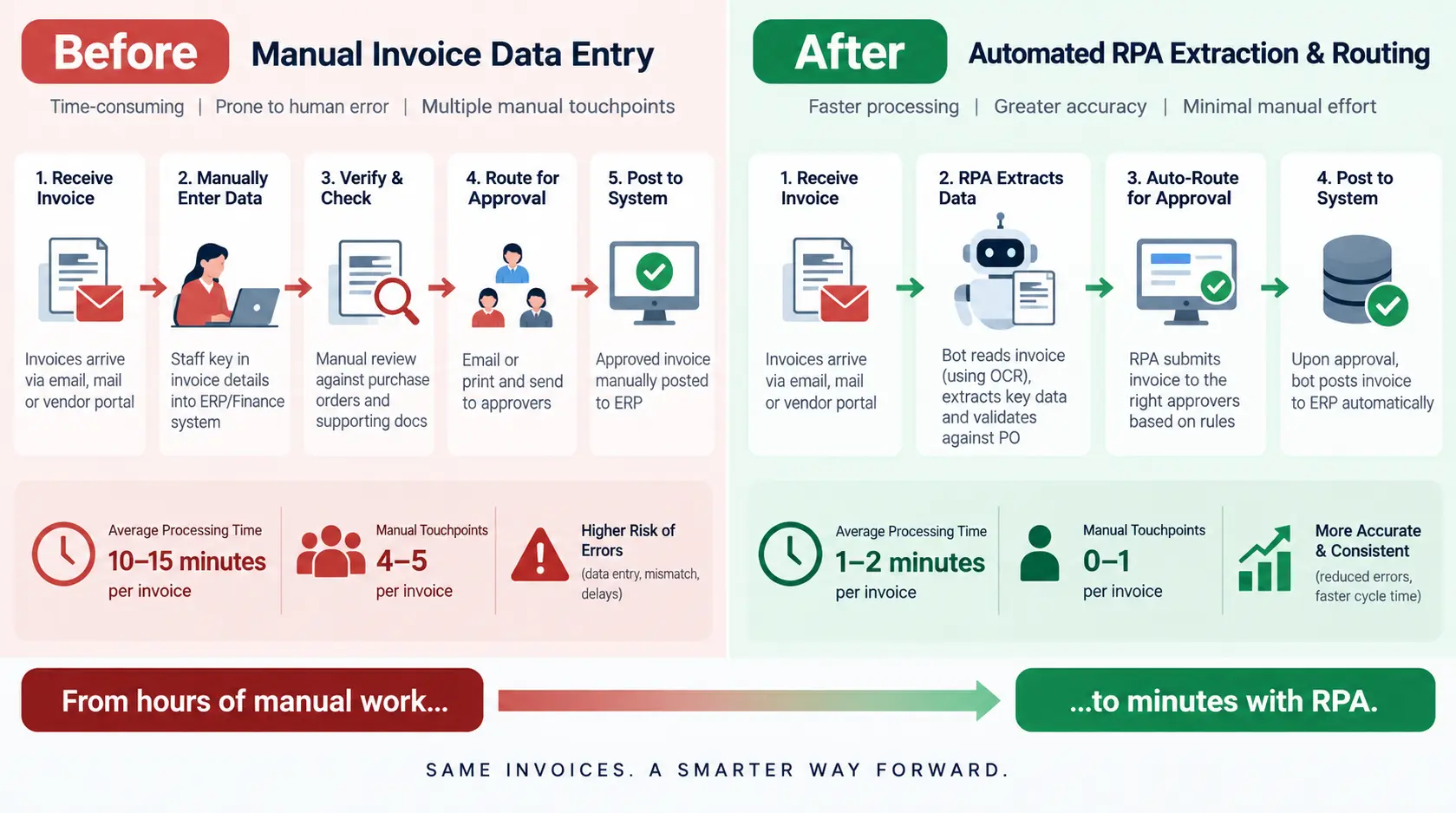
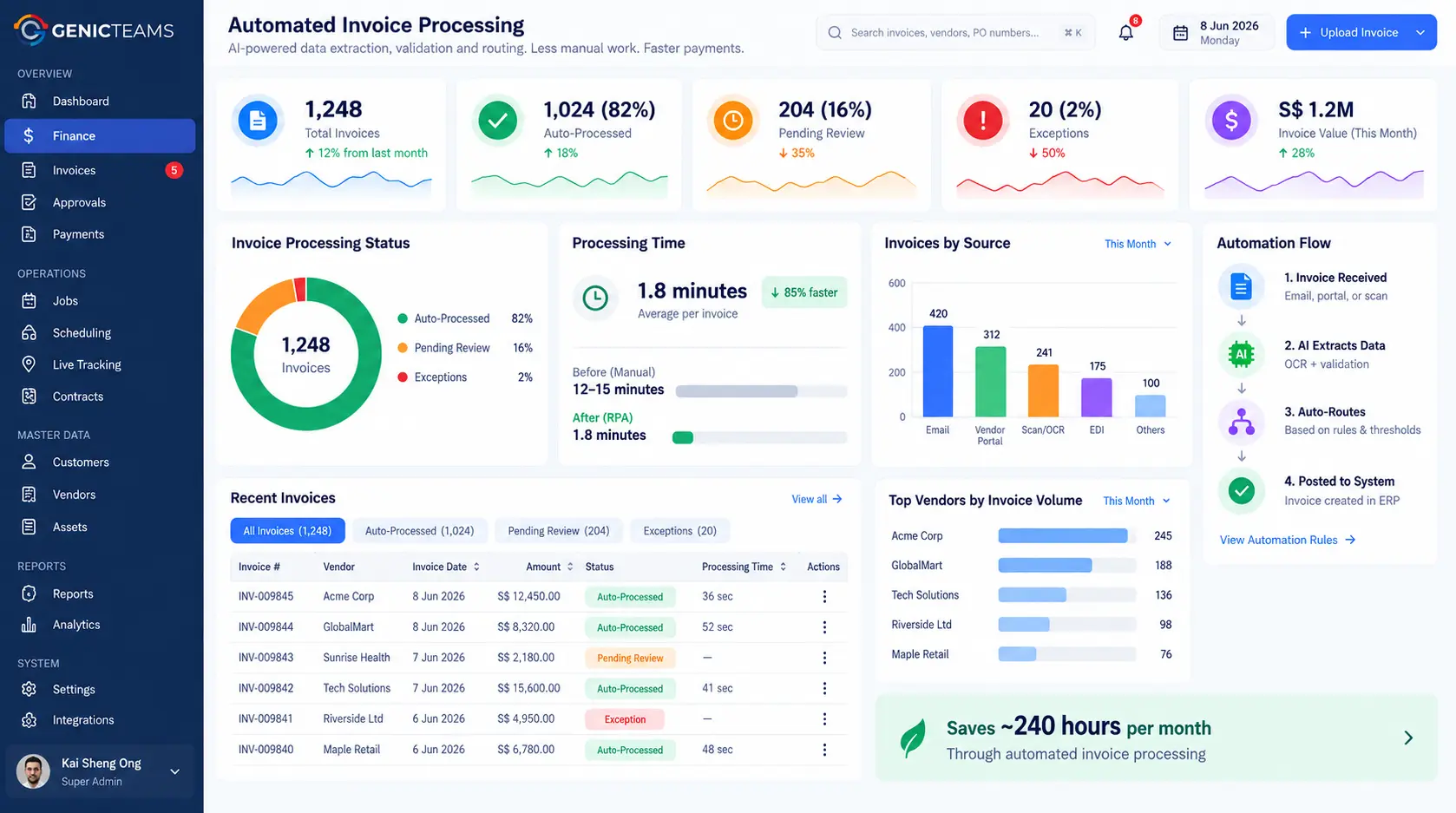
1. Invoice Processing
Invoice handling can involve opening files, collecting supplier information, entering invoice details, checking purchase orders, and sending records for approval.
RPA can complete many of these steps based on set business rules.
Automation can capture invoice data, validate required fields, match records, and route exceptions to the right employee. Staff can then focus on cases that need investigation instead of processing every invoice by hand.
2. Accounts Payable Processing
Accounts payable teams often repeat the same checks across large numbers of transactions.
RPA can support tasks such as validating supplier details, checking payment information, updating records, and preparing approved transactions for the next stage.
This is one of the most practical RPA examples for SMEs in Singapore businesses can consider when finance teams spend too much time on transaction processing.
3. Bank Reconciliation
Reconciling transactions can take hours when employees need to compare records across different sources.
RPA can collect transaction data, compare values against internal records, and flag differences for review.
Instead of checking every transaction, finance employees can spend their time investigating mismatches.
These three processes are useful RPA use cases for finance and HR teams because they combine clear rules with repetitive workloads.
Which HR Processes Can Benefit From RPA?
HR teams deal with people, but much of their administrative workload involves structured processes and data. Automation can remove some of that administration without taking the human element out of HR.
4. Employee Onboarding
A new employee can trigger a long checklist.
HR may need to create records, enter personal information, send forms, notify departments, and prepare system access requests.
RPA can trigger these standard actions after a candidate accepts an offer or reaches another defined stage. It can also check whether required steps have been completed.
The result is a more consistent onboarding process and less manual coordination.
5. Leave and Attendance Administration
Leave management may require staff to review requests, check balances, update records, and send notifications.
Where policies have clear rules, RPA can support these steps and route unusual cases to HR.
Employees still make decisions where judgement is needed. Automation handles the routine administration around those decisions.
6. Payroll Data Preparation
Payroll depends on accurate information.
HR teams may need to collect attendance records, overtime data, leave information, and employee changes before each payroll cycle. Manually transferring this information can create errors.
RPA can gather and validate data before payroll processing begins. Missing or inconsistent records can be flagged for staff to review.
For companies exploring RPA use cases for finance and HR, payroll preparation is often worth assessing because the work repeats on a fixed schedule.
Which Sales and Customer Service Processes Can SMEs Automate?
Automation is not limited to back-office departments. Sales and customer service teams also spend time on repetitive administration. Removing some of this work can give staff more time to speak with customers.
7. Customer Data Entry
A new customer may provide details through a form, email, or another digital channel. Employees then enter the same information into internal systems.
This creates duplicate work and increases the risk of typing errors.
RPA can transfer structured customer information between systems and check that required fields are complete. This can improve record quality while reducing manual data entry.
8. Sales Order Processing
Order processing often follows a set workflow. An employee may receive an order, check customer information, enter product details, confirm stock information, and update the order status.
RPA can handle many rule-based steps and flag exceptions such as incomplete information or values outside defined limits.
This is one of the useful automation use cases for SMEs that process a high number of standard orders.
9. Customer Request Routing
Not every customer request needs to be reviewed from scratch.
Routine requests can often be classified based on information such as account number, request type, or selected category.
Automation can collect these details and send the request to the correct team or workflow. This reduces the time employees spend sorting work before solving the actual customer issue.
Which Operations Processes Offer Strong RPA Opportunities?
Operations teams often sit at the centre of a business. They connect departments, monitor workflows, and make sure information reaches the right people.
That makes operations a natural place to look for RPA use cases.
10. Inventory Record Updates
Businesses that manage stock may need to update quantities across several records or systems.
Manual updates can cause mismatches. A wrong stock figure may then affect purchasing, sales, or customer communication.
RPA can move inventory information between approved systems based on defined events and rules. It can also flag differences that need a staff member’s attention.
11. Report Preparation
Weekly and monthly reporting can consume a surprising amount of time.
Employees may download several files, copy figures into a spreadsheet, organise the data and send the finished report to managers.
RPA can collect information from set sources, prepare standard report inputs, and distribute outputs based on a schedule. Managers still analyse the results, so the repetitive preparation work is automated.
This is one of the simplest RPA examples for organisations where teams spend hours creating the same reports each week.
12. Data Migration Between Systems
SMEs often use several business systems that do not share data in the way teams need.
Employees become the connection between them.
They copy information from one system and paste it into another. When transaction volumes grow, this approach becomes hard to manage.
RPA can transfer structured information between existing systems without requiring employees to re-enter each record.
For more complex requirements, businesses may need software development alongside automation to create integrations or workflows that match their wider technology environment.
How Should An SME Choose Its First RPA Use Case?
The first automation project does not need to transform the whole business.
A narrow, high-volume process can be a better starting point. It gives the organisation a chance to test the workflow, measure results, and learn how automation fits into daily operations.
Start by identifying processes that consume staff time each week. Then look at transaction volume, error rates, process stability, and the number of systems involved.
A process that takes five minutes but happens 1,000 times a month may offer more value than a two-hour task completed once per quarter.
Focus On Measurable Problems
Before implementing automation, define the problem in simple terms.
For example, the team may spend 40 hours each month entering invoices where customer orders may sit in a queue because employees need to re-enter information. A monthly report may take two days to prepare. These are measurable problems.
After implementation, operations managers can compare processing time, error rates, backlog size, or staff hours against the original figures. This makes it easier to judge whether the automation is delivering useful results.
What Should SMEs Avoid When Planning RPA?
A common mistake is automating a poor process without fixing it first.
If a workflow contains unnecessary approvals, duplicate steps, or unclear rules, automation can preserve those problems instead of solving them.
- Review the process before building the automation.
- Remove steps that no longer serve a purpose and define who handles exceptions.
- Another mistake is choosing a process that changes every few weeks.
- Automation depends on stable rules.
- Frequent changes can increase maintenance work.
Security and access also need attention. Automated processes may handle financial, customer, or employee information. Businesses should define access rights, keep suitable records and apply the same data controls they use for other business systems.
Experienced RPA services can help businesses map processes, assess technical requirements, and identify where automation fits within existing operations.
How Can Singapore SMEs Build A Wider RPA Roadmap?
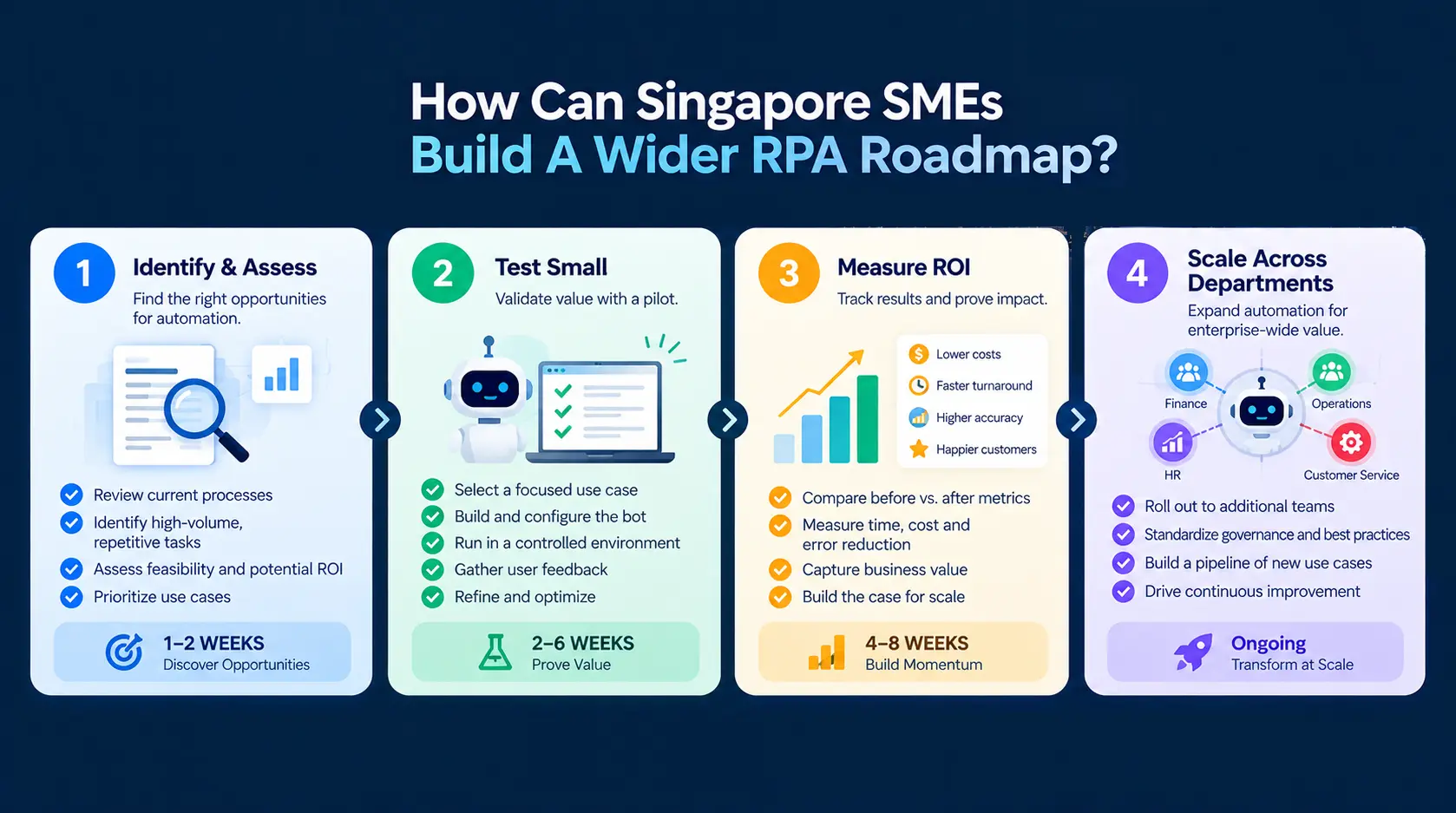
One successful automation should be the start of a structured programme, not a reason to automate everything.
Create a list of potential processes across finance, HR, sales, customer service and operations. Estimate how much manual effort each process requires and how often it runs.
Then consider complexity.
A high-volume process with stable rules and few exceptions may be suitable for an early project. A process involving several legacy systems, frequent changes, and many judgement calls may require more planning.
As the programme grows, review how RPA connects with wider software development plans. Some processes may need automation, while others may benefit from system integration or a redesigned application.
This helps prevent RPA from becoming a collection of disconnected fixes.
Conclusion
Overall, RPA creates the most value when it solves a specific operational problem. For Singapore SMEs, that could mean reducing invoice processing time, removing repetitive payroll preparation, keeping customer records consistent, or cutting hours from monthly reporting.
The 12 RPA use cases covered here give operations managers practical places to start. The right choice depends on transaction volume, process rules, current workload, and the systems already in place.
- Start with processes that are repetitive, stable, and easy to measure.
- Define the current cost or time involved.
- Automate a focused workflow and track the result.
Once the first project proves its value, the business can explore more automation use cases across departments and build a wider roadmap.
For SMEs assessing RPA examples for SMEs in Singapore, the aim should not be automation for its own sake. It should be simpler operations, fewer manual errors, and more time for work that needs people.