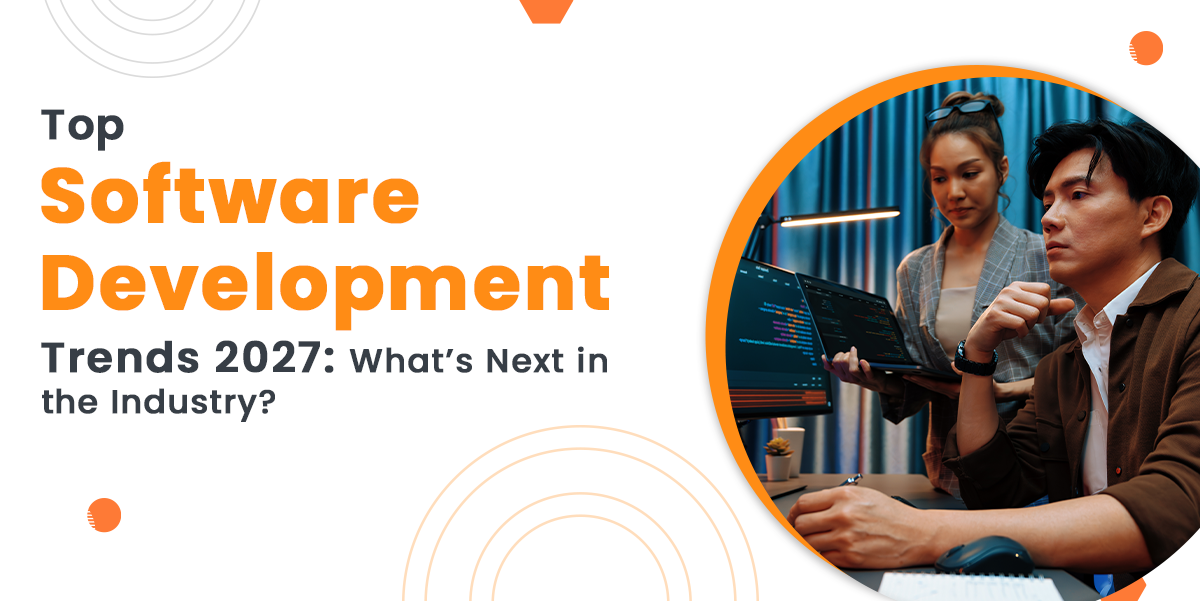
The software development landscape is going through a significant transformation as we approach 2027, driven by emerging technologies, functional shifts, and changing business needs. From automation and immersive platforms to sustainability and asset verification, modern software development is no longer just about writing code, as it’s about creating scalable, secure, and future-ready digital ecosystems.
The world is changing quickly, and developers, IT leaders, and cross-functional teams are adapting to stay competitive while maintaining agility and speed.
The top software development trends for the industry in 2027 are discussed from democratization of app creation with low-code resources to the rise of FinOps, GreenOps and real-time cybersecurity automation. Understanding these AI coding trends is essential to creating systems that are resilient, efficient, and sustainable, whether you are leading a tech team or even shaping digital strategy.
Build Custom Software That Fits Your Business
From CRM to inventory systems — we design solutions around your workflow, not the other way around.
Top Software Development Trends in 2027
1. Low-Code Strategies Driving Agility Across Business Functions
In the upcoming year, low-code and no-code (LCNC) platforms will become an important part of enhancing enterprise productivity. These tools help people from non-developers background to build and automate workflows, apps, and dashboards, as they can be utilised by marketers, operations managers, or customer support representatives without writing any code manually.
The democratisation of software creation reduces the dependency on IT teams. LCNC platforms will become a lot more powerful as more integration is done between them and other business methods, such as CRMs, ERPs, and AI services.
The developers will focus on more complex engineering tasks, and this shift also improves agility during prototype or MVP custom software development by encouraging a culture of experimentation across departments.
As these platforms become more mature, the line between professional and citizen developers will become blurred even more, with AI-driven code suggestions, drag-and-drop interfaces, and reusable components. The organisations move more quickly, collaborate better, and build smarter.
2. Cybersecurity Automation Strengthening Real-Time Threat Protection
By 2027, cyber threats will be moving increasingly rapidly, and cybersecurity will have to keep up. Automation in threat detection and response will no longer be optional but a core component of every strategy. Nowadays, systems can monitor huge networks for anomalies, adapt to new attack patterns as well as initiate automated responses in real- time using AI and machine learning.
This proactive strategy greatly reduces incident response time from hours to milliseconds. It isn’t just about firewalls anymore. But we are talking about our self-healing systems, automated patch management, and predictive analytics, which determine vulnerabilities before they are exploited.
This means integrating security earlier in the DevOps pipeline (DevSecOps) and relying on automated tools to ensure continuous compliance for developers.
Cybersecurity automation will become more important as regulations become stricter and cyberattacks become more advanced. By 2027, the most secure systems will no longer be those of humans guarding them, but will be protected by algorithms operating around the clock.
3. Transforming Operations with Scalable IoT Ecosystems
The Internet of Things (IoT) is moving beyond smart homes to everything. IoT ecosystems will be embedded in various industries by 2027, including healthcare, logistics, agriculture, and manufacturing, becoming a core pillar of AI coding trends for 2027.
The utilisation of real-time sensors and connected devices will pass information to centralised platforms constantly, which enables live monitoring, predictive maintenance, and process optimisation.
For instance, manufacturing facilities modifying machine behavior dynamically based on sensor feedback, or hospitals tracking patient vitals 24/7 with smart wearables. The task for developers is to integrate various devices, manage edge computing, and make certain data security across networks.
The combination of 5G connectivity as well as cloud-based IoT platforms can allow it to be simpler to gather, process, and act on data within milliseconds.
In addition, IoT information will more and more feed AI models to discover patterns and enhance decision-making.
Also Read: Top Software Development Trends 2026
4. Optimising Cloud Strategy with FinOps and GreenOps Practices
The costs and carbon footprints will increase as cloud usage grows. That’s why in 2027, FinOps as well as GreenOps are going to become crucial operational disciplines. FinOps focuses on maximizing cloud spend across engineering and finance teams by providing much better visibility, shared accountability, and real-time financial insights.
While GreenOps concentrates on lowering the environmental impact of IT operations by monitoring energy consumption and carbon emissions, especially in the cloud infrastructure.
They promote sustainable growth together: As eco-conscious engineering, cost-efficiency, and resource optimisation are smarter resource allocations. With enterprises aiming for net-zero objectives as well as budget transparency, software teams are utilizing tools that provide real-time dashboards that show both monetary and carbon metrics.
5. AR/VR Adoption Driving Innovation Across Training, Collaboration, and Design
In the upcoming year, Augmented Reality (AR) and Virtual Reality (VR) platforms will move from being a niche gaming platform to becoming essential.
As immersive technologies are transforming industries from training and design to retail and healthcare. For instance, imagine remote technicians receiving real-time AR repairs or employees attending immersive VR onboarding sessions that feel like the real world.
This shift creates significant opportunities for developers, like designing better interfaces for 3D environments, optimising performance for wearable devices, and integrating these immersive experiences with enterprise systems such as ERPs and CRMs. Advances in hardware including lighter AR glasses and more compact headsets.
As digital and physical worlds converge, expect a new category of hybrid apps that blend on-screen functionality with spatial awareness. AR/VR is no longer just a future bet as it’s a strategic tool for engagement, efficiency, and training in the modern enterprise.
Also Read: Software Development Services Explained
6. Leveraging Blockchain and NFTs for Transparent Asset Management
In the business community, NFTs (non-fungible tokens) are gaining new use. By 2027, companies will increasingly depend on blockchain-based tokenisation in order to authenticate, track, and control both physical and digital assets.
No matter whether it’s confirming the foundation of a product in the supply chain so obtaining access to proprietary code, or even the issuance of electronic certificates of ownership, NFTs provide a tamper-proof, decentralised solution. This enhances transparency, which makes it simpler to comply and creates trust among stakeholders.
This is a trend that is best suited for increased proficiency with smart contracts, secure wallet integrations, and blockchain interoperability for programmers engaged with custom software development. As a part of digital asset management as well as license programs, enterprise platforms will have native support of NFTs.
In the future of software development, NFTs won’t just be collectibles as they’ll be critical tools for protecting intellectual property, ensuring traceability, and securing digital ecosystems.
Conclusion
Software development trends for the year 2027 show a clear trend towards smarter systems, including technology, and responsible development. Low-code platforms expand who can build solutions, while cybersecurity automation and IoT ecosystems bring real-time intelligence to operations.
However, practices such as FinOps and GreenOps are defining the growing need for environmental accountability as well as cost-efficiency. Emerging technologies like NFTs and AR/VR are no longer experimental, but they are starting to be useful resources for business growth, security, and engagement.
Both developers and decision-makers must adapt to these changes and also shape them actively. The future of software is much more conscious, connected, and faster than ever before.