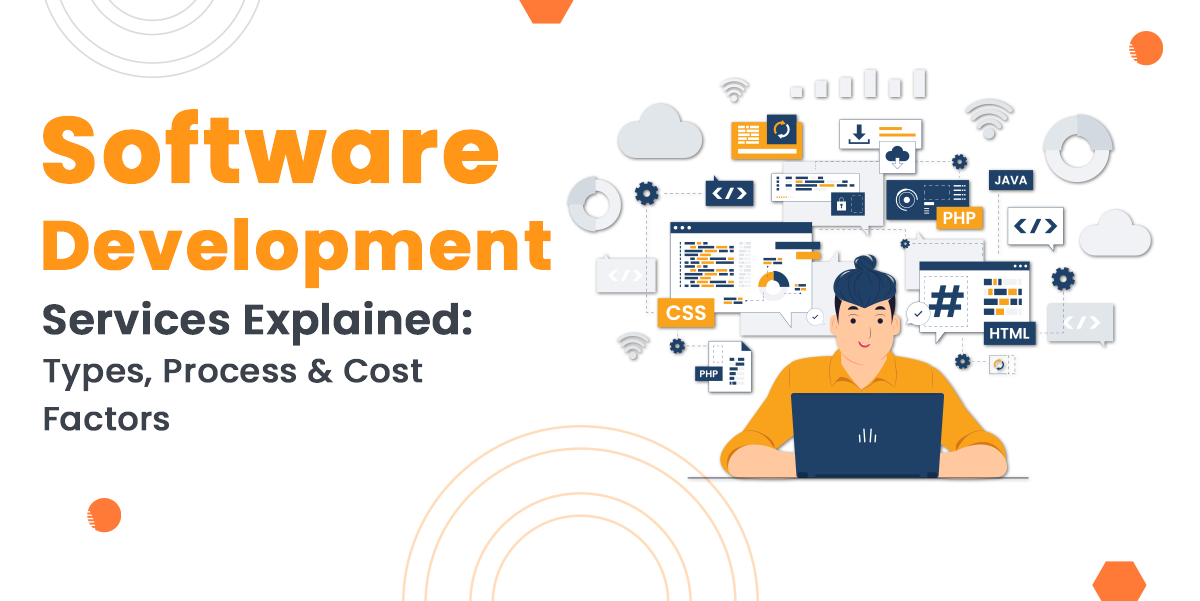
Software development services include creating a software solution that meets specific business requirements through a well-defined approach. The development process of software makes sure each software or app is created using planned, designed, and tested precision.
Understanding a development cycle is very important, along with exposure to different types of development services and factors that affect the cost of developing software. Let’s explore below
What Is Software Development?
In 2026, software development is defined as the multi-step process of designing, building, deploying, and maintaining software solutions that range from mobile apps and web platforms to complex enterprise systems and embedded hardware.
The goal of software development is to create a product that fulfills the customer or user needs and business objectives efficiently and securely.
What are the Types of Software Development Services
1. Front-end Development
Front-end development focuses on building the User interface part of websites and apps, such as layout, interactivity, and design. In this development, the technology uses include HTML, CSS, and JavaScript.
2. Back-end Development
Back-end development manages the back-end part or logical part, which helps to run the websites and software. Developers work on data storage, processing, and server logic using languages such as Python, Java, and C++.
3. Full-Stack Development
A full-stack developer includes both front-end and back-end tasks, which allows them to build an entire software system from planning to execution.
In full-stack development, several technologies are used, such as programming languages(PHP, C++) and integrating systems across web, mobile, and desktop platforms.
4. API Development
API development involves designing and maintaining interfaces that let different applications communicate.
API sets rules for data sharing, performing actions, and integrating systems across web and desktop platforms.
Developers often use JavaScript and Python along with API calling tools.
5. Database Development
Database development, including designing and maintaining a system that stores and organizes data efficiently.
In these types of software development services, several types of databases are used, including relational, non-relational, NoSQL, and Big Data databases.
6. Embedded System Development
Embedded system development builds specialized computing systems inside larger devices and machines. These appear in cars, appliances, robots, and medical tools.
Developers work with middleware, C, C++, and real-time operating systems designed for embedded use.
7. Cloud Software Development
Cloud Development includes building applications that run on cloud platforms for better scalability, reliability, and cost efficiency.
Developers use cloud-friendly languages, environments, and CI/CD pipelines to deploy cloud apps
What is the Process of Software Development Services?
The process of software development services follows the Software Development Lifecycle(SDLC). Let’s explore how each step is executed below:
1. Planning
Teams understand the business goals, user needs, and project feasibility. In 2026, there are several research tools that help to analyse market trends, predict user needs, and highlight integration requirements early.
This phase makes sure everyone understands the project direction before major work begins, which reduces risk and unnecessary effort later in the process.
2. Requirement Gathering
The stakeholder mentioned that everything in the document is either functional or non-functional in a large SRS document. This prevents misunderstanding and avoids scope creep by defining exactly what the software must deliver.
3. Architecture & Design
The Development Team creates the system’s structural blueprint by covering databases, APIs, and the overall technical flow. While designers create detailed UI/UX mockups and interactive prototypes to validate the user journey.
This phase turns abstract requirements into a concrete plan by ensuring both usability and technical scalability before development officially begins.
4. Development Phase
This is where the development teams come into the picture and start writing code to convert the design and features from the paper to the actual implementation.
In this phase, they create boilerplate code and help to maintain code quality. This helps engineers to focus on complex logic, integrations, and performance.
5. Testing & QA
In this step, the software undergoes testing of its functionality, security, smoothness, and performance. Modern pipelines follow a shift-left approach where issues are detected earlier through automated checks.
QA teams validate reliability and identify vulnerabilities long before deployment. This consistent testing ensures the final products meet expectations so they remain and perform well under real-world conditions.
6. Deployment & Maintenance
The finished product goes to the deployment or production team to check the scalability of a product. Nowadays, teams rely on canary and blue-green deployment to reduce risk and expose changes to a small number of users first.
Then software checks for ongoing support where teams track performance with observability tools and apply patches, fix issues to optimise features based on real user feedback.
Factors Which Affect the Cost of Custom Software?
Custom software Singapore costs are not random, but they are influenced by several key factors which depend on the complexity, duration, and more. Let’s find it below:
1. Project Complexity and Scope
A simple product with limited features costs far less than large systems with many integrations. A small information site may cost SGD $13,500-$67,500, while a full enterprise platform can cost more than SGD $1.35M. The scope plays a major role in each feature or integration effort. Even small mid-project requests often require more than expected, raising overall cost.
2. Tech Stack
The chosen tools and framework affect development speed and cost. New technologies may require highly paid specialists, while traditional systems need niche expertise. Selecting the right stack is always a combination of upfront costs, future maintenance, and performance needs.
3. Development Methodology
The agile, waterfall, and hybrid methods impact the cost differently. Agile allows flexibility, but can expand the scope if not properly managed. While waterfall offers predictable budgets but allows very limited changes. Technology choices also impact the software outsourcing, as different regions specialise in different stacks.
4. Quality Assurance and Testing Requirements
Thorough testing can take 20-40% of the budget. Industries like finance and healthcare may send even more due to strict standards. Automated testing tools require an initial investment but reduce long-term costs, while manual testing is cheaper at the start but slightly increases as the system grows.
Also Read: Guide To Know Everything About Software Development
Why Genic Solutions is the Best Provider of Software Development Services?
Genic Solutions stands out as a trusted partner for businesses seeking reliable, scalable, and high-quality software. We combine strong technical expertise with a customer-focused approach and ensure every solution is built to meet real operational needs rather than forcing clients into generic systems.
Our team works across modern and legacy technologies, which allows us to deliver software that performs well today and adapts to future growth.
A major advantage of partnering with us at Genic Solutions is our commitment to tailored development.
Each project begins with a detailed understanding of the client’s goals, workflows, and industry challenges.
We also maintain transparent pricing and disciplined project management. Clear communication, well-defined scope, and structured processes help clients avoid unexpected costs and delays.
Our Agile-driven approach provides frequent updates, early visibility into progress, and the flexibility to adapt when business requirements change.
Overall, we offer a balanced mix of expertise, adaptability, and long-term partnership that makes us a standout choice for software development services.
Conclusion
Choosing the right software development partners is important for getting long-term success, and understanding the types of services, cost factors, and process of software development helps to make the right decision.
With an increasing demand for scalable systems and seamless user experiences, businesses need solutions that are built with precision and reliability. A well-structured approach supported by modern tools, thorough testing, and regular maintenance.
By aligning technology with business goals, the right partner helps organisations to create and deliver confidently, which reduces risk and maintains a competitive edge in the digital market.