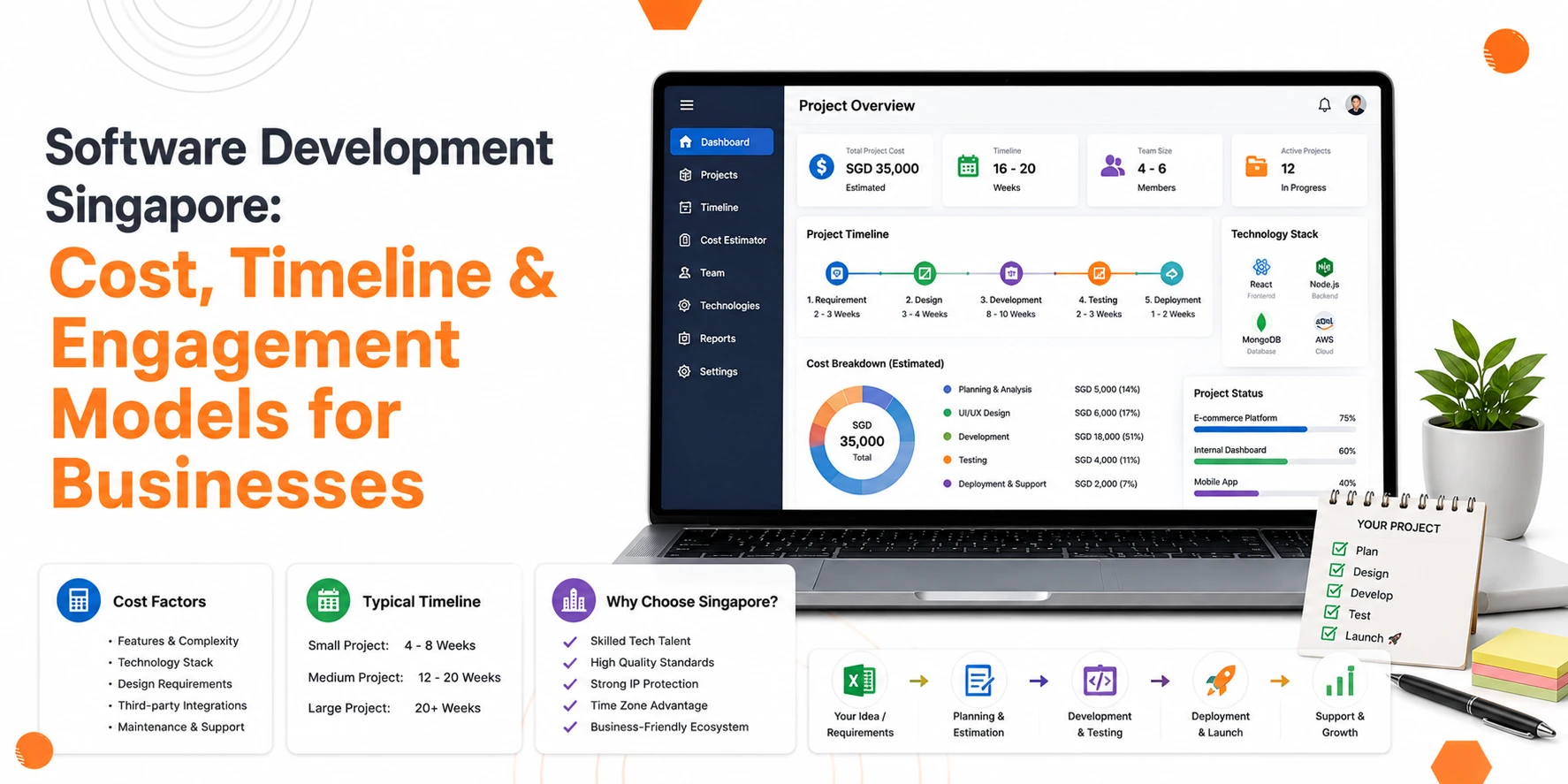
Software development in Singapore allows businesses to create customised solutions that meet specific needs efficiently. Costs vary based on project size and complexity, timelines depend on scope and integrations, and engagement models like fixed-price, time-and-materials, dedicated teams, or staff augmentation determine how you work with developers. Choosing the right approach ensures quality, compliance, and scalability while controlling costs.
In this guide, you will learn everything you need to know about software development in Singapore, along with costs, timelines, and engagement models in depth.
Build Custom Software That Fits Your Business
From CRM to inventory systems — we design solutions around your workflow, not the other way around.
Why Software Development in Singapore Makes Sense?
Singapore is a top tech hub with government support, skilled talent, and businesses that adopt new technology quickly. This creates a strong market for custom software development that fits specific business needs.
Companies across finance, healthcare, and retail use software to grow. They need systems that fit their unique needs. Off-the-shelf products often fall short. That is where custom software development comes in.
A good software development company in Singapore understands the local market. They know the rules and regulations and can build solutions that work for your business.
How Much Does Software Development Cost in Singapore?
Software development costs in Singapore range from $20,000 for a basic MVP to over $500,000 for complex enterprise systems. The final price depends on project size, application type, features, and team location.
Let us get straight to the point, as cost is a major concern. The software development cost in Singapore varies widely depending on several factors.
Cost by Project Size
Projects fall into three main sizes. Each has a different price range.
| Project Type | Typical Cost (SGD) | What It Includes |
|---|---|---|
| Basic/MVP | $20,000 – $80,000 | Core features, simple design, basic functionality |
| Mid-scale | $80,000 – $250,000 | More features, integrations, user roles, and better design |
| Enterprise | $250,000 – $500,000+ | Complex workflows, high security, large-scale operations |
An MVP is a minimum viable product. It lets you test your idea quickly. You build the basic version first, and you add features later. This approach saves money in the early stages.
A mid-scale project might be a custom CRM or an e-commerce platform which connects with other tools you already use.
Enterprise solutions are for large organisations because they handle heavy workloads that need strong security and reliability.
Cost by Application Type
Different apps cost different amounts. Here is a breakdown.
| Application Type | Typical Cost (SGD) | What It Includes |
|---|---|---|
| Web Application | $7,500 – $75,000+ | Responsive design, user accounts, data management |
| Mobile Application | $7,500 – $150,000+ | iOS and Android versions, offline support, push notifications |
| SaaS Platform | $80,000 – $300,000+ | Multi-tenant architecture, subscription management, and billing |
| Enterprise System | $200,000 – $500,000+ | Complex integrations, custom workflows, and high security |
Web apps are usually cheaper than mobile apps. Mobile apps need extra work as they must perform well on different devices. They also need to work offline sometimes.
SaaS platforms cost more because they serve many customers. They need strong infrastructure and billing systems.
What Makes the Cost Go Up?
Several things increase the final bill, so knowing these helps you plan.
- Feature Complexity: The cost of basic screens remains low because they have basic design elements. The addition of AI technology, chatbots and blockchain systems leads to increased system costs.
- Design Quality: Custom animation-based designs require higher financial outlays when compared to using pre-designed templates.
- Backend Needs: A basic database system costs less than systems that require instant data processing capabilities.
- Third-Party Integrations: The process of linking payment gateways and additional software systems demands extra operational work.
- Team Location: Developers based in Singapore demand higher fees than teams that operate from distant locations. The difference can be 2-3 times.
Hidden Costs You Should Know About
The development cost is not the only expense. Plan for these extras.
- Maintenance: After launch, you need support. Budget 15-25% of the initial cost each year for maintenance.
- Hosting and Infrastructure: Servers and cloud services cost money. These grow as your users grow.
- Recruitment: If you hire in-house, expect to spend time and money finding the right people. It can take 4-12 weeks to fill a role.
- Benefits and Equipment: In Singapore, employee benefits and office space add 20-30% to salaries.
A smart move is to look at the total cost, not just the first bill. The cheapest option upfront might cost more in the long run.
How Long Does Software Development in Singapore Take?
Project timelines range from 2-4 months for an MVP, 4-9 months for mid-scale projects, and 9-18+ months for enterprise solutions. Scope changes and integration complexity are the main causes of delays.
The software development timeline is another big question. You want your product ready fast. But quality takes time.
Typical Timelines by Project Size
| Project Type | Typical Timeline |
|---|---|
| MVP | 2 – 4 months |
| Mid-scale Project | 4 – 9 months |
| Enterprise Solution | 9 – 18+ months |
An MVP takes the least time. You build only the essential features. You launch faster and get user feedback early.
Mid-scale projects take longer. They have more features and integrations. You need more testing.
Enterprise projects take the longest. They are complex. They might have multiple phases. Each phase could take several months.
Factors That Extend the Timeline
Many things can push your delivery date back.
- Scope Changes: New features added mid-project delay everything. Stick to your plan.
- Integration Complexity: Connecting with old systems is hard. It takes extra time to make everything work together.
- Testing Needs: Thorough testing is essential. But it adds weeks to the schedule. Do not skip it.
- Team Availability: Finding developers in Singapore is competitive. The best ones are busy. You might wait months to start.
The Planning Phase Is Critical
Good planning speeds up development. Spend time on it. Define your features clearly. Create user stories. Design the user experience.
End-to-end software solutions start with good planning. When you know exactly what you need, developers can work faster. They do not waste time guessing.
How to Choose the Right Engagement Model
The four main engagement models are Fixed-Price, Time-and-Materials, Dedicated Team, and Staff Augmentation. Each suits different project types. Fixed-Price offers predictability. Time-and-Materials offers flexibility. Dedicated teams work on long-term projects. Staff augmentation fills skill gaps. Here are the main options.
1. Fixed-Price Model
You agree on the scope and price upfront. The vendor delivers what you agreed upon. Changes cost extra.
Best for: Well-defined projects with stable requirements.
Pros:
- You know the total cost from day one
- The vendor manages the work
- Less risk of budget overrun
Cons:
- Limited flexibility
- Changes are expensive
- The vendor might add safety buffers to the price
Cost Predictability: High | Flexibility: Low
2. Time-and-Materials Model
You pay for the actual time and resources used. The scope can change as you go.
Best for: Projects with evolving requirements or MVPs.
Pros:
- You can change priorities easily
- You pay for work actually done
- Good for exploring ideas
Cons:
- Final cost is uncertain
- You need to manage the work actively
- Requires good communication
Cost Predictability: Medium | Flexibility: High
3. Dedicated Development Team Model
You hire a full team that works on your project exclusively. They act like your own staff.
Best for: Long-term projects and ongoing development.
Pros:
- Full control over priorities
- Team builds deep knowledge of your business
- Easy to scale up or down
Cons:
- Requires strong management on your side
- Longer setup time
- Not suitable for short projects
Cost Predictability: Medium | Flexibility: High
4. Staff Augmentation
You bring in external developers to join your existing team. They work under your management.
Best for: Filling skill gaps or handling peak workloads.
Pros:
- You keep full control
- Faster hiring
- Access to specific skills
Cons:
- You manage the work
- Less suitable for long-term needs
- Your internal team must handle coordination
Cost Predictability: Variable | Flexibility: High
Which Model Should You Pick?
Your specific circumstances will determine which selection proves to be correct for you.
- Pick Fixed-Price if your requirements are clear and stable. The client needs to control their expenses because they want to maintain a fixed spending limit.
- Pick Time-and-Materials if you are still defining your product. You need flexibility to try things.
- Dedicated Team: Organizations should choose Dedicated Team services when they need to support their product development work, which extends across multiple years. You want a team that knows your business inside out.
- Pick Staff Augmentation: if you have a good internal team but need extra hands for a short time.
Important: Do not choose based only on cost. The initial cost of the cheapest model might not suit your project requirements. That leads to problems later.
Is the Offshore Option Good for Singapore Businesses
The offshore development process enables businesses to achieve cost reductions between 40-60% while they can select from an expanded pool of skilled workers and experience quicker staff onboarding and adjustable workforce expansion. Organizations need to develop particular operational systems that will allow them to handle the risks that emerge from working across different time zones while maintaining continuous communication channels. The method produces distinct advantages for its users.
Why Consider Offshore Development?
- Cost Savings: Developers in Singapore cost between $3,000 and $12,000+ per month. The same skills that people have in Vietnam require monthly payments between $900 and $4,500+. That is a 40-60% saving.
- Access to Talent: Singapore faces constraints because it only possesses a few available job candidates. The search for competent developers proves to be quite challenging. The offshore industry provides businesses with access to an expanded selection of qualified professional workers.
- Faster Hiring: Hiring in Singapore can take 4-12 weeks. The process for offshore teams to begin work usually takes between one and three weeks.
- Flexible Scaling: You can grow or shrink your team as needed. This is hard with an in-house team.
Risks and How to Avoid Them
Offshore work has challenges, too. Here is how to handle them.
- Time Zone Differences: Require daily overlap hours with your team. This ensures good communication.
- Cultural Differences: Choose a partner with experience working with Singapore businesses. They should understand your expectations.
- Quality Concerns: Do your homework. Check the team’s past work. Test their skills before you commit.
- Communication Gaps: Use clear documentation. Have regular video calls. Keep communication simple.
Finding the Right Partner
A good offshore partner handles the hard parts for you. They manage recruitment. They ensure quality. They handle communication. You focus on your business.
Look for a partner who offers scalable software development services. They should grow with you. They should provide end-to-end software solutions from planning to support.
How to Plan Your Software Project
You can start by defining your scope clearly. Set a realistic budget. Choose the right engagement model. Consider location options. Get everything in writing before work begins. Let’s explore more about the following:
Step 1: Define Your Scope Clearly
Know exactly what you are building. List every feature. Describe every user role. Detail all integrations.
The more specific you are, the better the estimate. Vague requirements lead to delays and cost overruns.
Step 2: Set a Realistic Budget
Look at the cost ranges in this guide. Add a buffer for unexpected issues. Remember the hidden costs like maintenance and hosting.
Talk to a few software development companies in Singapore. Get quotes. Compare them. Ask what is included and what is not.
Step 3: Choose Your Engagement Model
Decide which model fits your project and management style. Be honest about your capacity to manage the work.
If you have a strong technical team, staff augmentation might work. If you want to hand over the entire project, a fixed price could be better.
Step 4: Consider Location
Think about whether to use a local team, an offshore team, or a hybrid model. Weigh the pros and cons.
Offshore offers cost and talent advantages. Local offers proximity and easier communication. Some companies use both.
Step 5: Get Everything in Writing
Before work starts, sign a clear agreement. Cover these points:
- Project scope and deliverables
- Timeline and milestones
- Payment terms
- Intellectual property ownership
- Confidentiality
- What happens if the scope changes
- Support and maintenance after launch
This protects both sides. It prevents misunderstandings later.
Conclusion
Now you have the information about costs, timelines, and engagement models for your software project. The next step is taking action, and that starts with writing down your project requirements in detail.
You should contact multiple software development firms in Singapore to obtain price estimates and service proposals, which you must evaluate based on complete value instead of focusing on cost amounts. The main objective is to create software solutions that solve actual business challenges and produce measurable outcomes.
Your perfect partner will direct you through all phases of your project while they shield you from typical errors and produce a solution which meets your company’s needs.