Robotic process automation can remove repetitive work from daily operations. It can speed up routine tasks, reduce manual errors, and give teams more time for work that needs human judgement.
But those benefits do not come from automation alone.
A strong RPA implementation needs the right process, clear goals, good planning, testing, and support after launch. If a business automates the wrong task or skips key preparation, the project can become harder to manage than the manual process it replaced.
This matters for Ops and IT teams. They sit at the centre of most automation projects. Operations teams understand how the work happens. IT teams understand the systems, controls, security needs, and technical limits. Both sides need to work together.
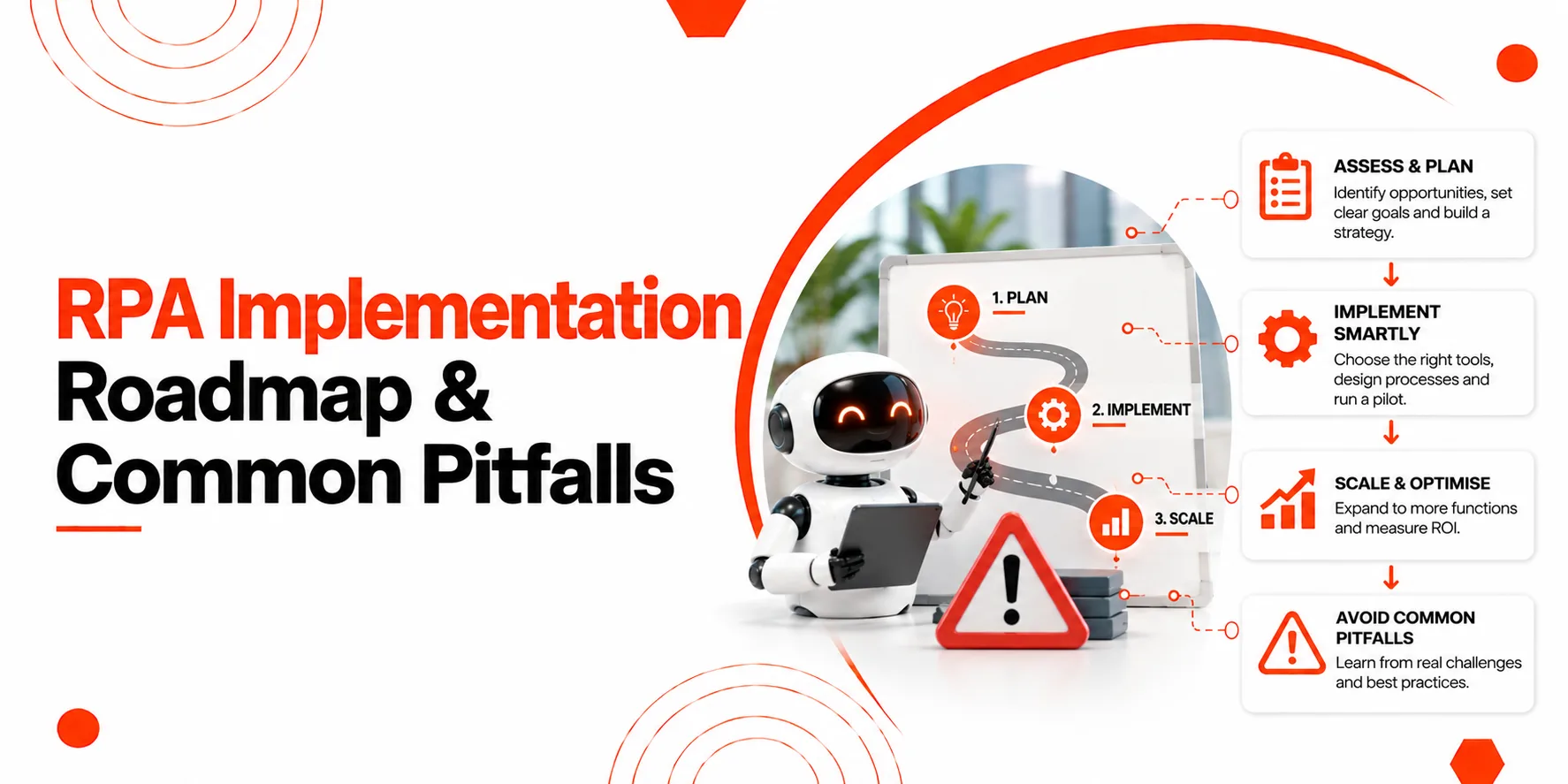
This guide covers a practical RPA roadmap, from choosing a process to managing it after launch. It also explains RPA challenges, common mistakes, and what businesses in Singapore should consider when planning automation.
Build Custom Software That Fits Your Business
From CRM to inventory systems — we design solutions around your workflow, not the other way around.
What Should You Understand Before Starting RPA Implementation?
Before discussing implementation, it helps to understand what is RPA.
RPA uses software-based automation to carry out structured, rule-based tasks that people would otherwise complete through business systems. These tasks may include moving data between systems, checking records, processing standard requests, updating fields, creating reports, or handling routine back-office work.
The best candidates tend to follow clear rules and use structured data.
For example, imagine an operations employee who downloads a standard report each morning, checks several fields, copies approved values into another system, and records the result. If the steps follow stable rules, much of that workflow may be suitable for automation.
The goal should not be to automate every task. It should be to find work where automation creates a clear business benefit.
That distinction shapes the whole RPA implementation roadmap.
How Should You Build the Business Case for RPA Implementation?
- Start with the problem rather than the technology.
- Ask what the business wants to improve.
It may need to reduce processing time, cut repetitive manual work, improve data accuracy, increase capacity, or create a more consistent process, and once the goal is clear, establish a baseline.
Also, record how the process works today and Measure factors such as processing time, transaction volume, error rates, manual effort, exception rates, and operating cost where useful.
This gives the team something to compare after RPA deployment. A business case should also include costs beyond the initial build. Consider implementation work, testing, maintenance, infrastructure, security, training, monitoring, and process changes.
How Can Ops and IT Agree on Success?
Define success before development starts.
Ops may focus on shorter processing times or fewer repetitive tasks. IT may focus on stability, security, support needs, and system impact.
These goals do not need to compete but create a small set of shared measures.
For example, the team could track hours saved, transactions processed, error rates, exception rates, process completion time, and support incidents.
Clear measures make it easier to judge whether the automation is producing the intended result.
What Are the Key RPA Implementation Steps Singapore Businesses Should Follow?
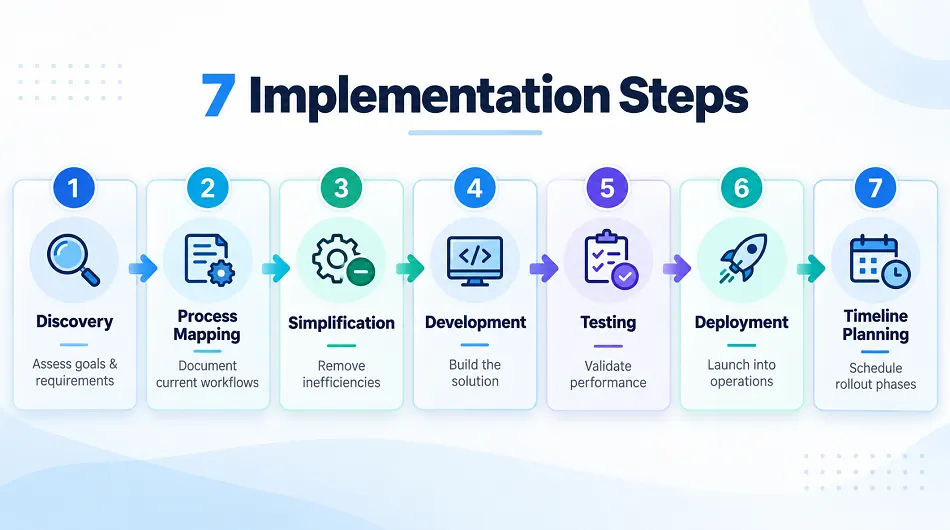
The core RPA implementation steps Singapore businesses need are similar to those used elsewhere. The local business environment can still affect priorities around governance, security, data handling, compliance, and scale.
A practical roadmap can be divided into seven stages.
Identifying the Right Processes for Automation
- Begin with process discovery.
- Speak with the people who complete the work each day.
- Look for repetitive tasks that take time, follow clear rules, use structured inputs, and occur in reasonable volumes.
- Do not choose a process because employees dislike it.
- A frustrating task is not always a good automation candidate.
A strong candidate should have stable steps and clear decision rules, so create a shortlist and compare each process against factors such as volume, complexity, stability, business value, exception rates, and system dependencies.
This creates a stronger starting point for RPA implementation.
Documenting the Current Process
Do not build automation from assumptions; try to map the process from start to finish. Document each input, action, decision, output, exception, system, and hand-off. Always pay close attention to the small steps.
A process may look simple when described by a manager but contain many manual decisions when performed by the operations team.
For example, a team may say, “We check the request and enter it into the system.” In practice, staff may check missing fields, compare reference numbers, correct formats, contact another department, and decide how to handle duplicate records.
Those details matter, as good process documentation reduces surprises during development and testing.
Simplifying the Process Before Automation
Automation should not preserve poor process design.
Before development begins, review whether any steps can be removed, combined, standardised, or redesigned.
A process that involves eight manual checks may only need five, while two approval stages may exist because of an old system limitation. A report may contain fields that nobody uses, so clean up these issues first.
The principle is simple is to: fix the process before automating it.
Businesses that already use software development services for system modernisation should also check whether a direct system change would solve the problem better than RPA. Automation is one option, not the answer to every workflow issue.
How Should You Design and Develop the Automation?
Once the process is stable, translate it into clear automation rules.
Define what starts the process, what information it needs, which systems it interacts with, what decisions it can make, what output it should produce, and what happens when something goes wrong.
Exception handling deserves close attention.
- Not every transaction will follow the ideal path.
- Records may be incomplete.
- Systems may be unavailable.
- A value may use an unexpected format.
- A business rule may produce no valid result.
The automation needs a defined response.
Some exceptions can follow another rule, while others should be passed to a person for review.
This is also where the difference between RPA vs AI matters. RPA works best when actions follow defined rules. Tasks that depend on interpretation, uncertain inputs, or complex judgement may require a different approach or human involvement.
How Should Testing Work Before RPA Deployment?
Testing should cover more than the perfect transaction.
Start by checking each part of the workflow, then test the full process from beginning to end.
Use normal cases, edge cases, incorrect data, missing data, system failures, and expected exceptions.
Ops staff should take part in user acceptance testing, as they know the real process and may spot cases that technical teams do not expect.
Security and access should also be tested.
The automation should have only the permissions required to complete its task. Credentials, access rights, logs, and data handling need suitable controls.
Do not rush RPA deployment because the main path works. A workflow that succeeds with clean test data may still fail during daily operations.
What should happen during RPA deployment?
Deployment should be controlled and measurable.
A pilot is often a useful starting point, so run the automation within a limited scope before expanding it across a larger operation.
During the pilot, track failures, exceptions, processing times, user feedback, and system impact.
Keep a fallback process in place during the early stage. If the automation stops, the operations team should know what to do next.
Ownership must also be clear.
Someone should know who monitors the process, who handles business exceptions, who investigates technical failures, and who approves future changes.
Without clear ownership, small issues can remain unresolved until they become larger operational problems.
What Should a Realistic RPA Deployment Timeline Include?
There is no single RPA deployment timeline that fits every project.
A small, stable process may move from discovery to production within several weeks. A complex process involving many systems, approvals, security reviews, or exceptions can take much longer.
Instead of setting a deadline before understanding the process, build the timeline around key stages.
Allow time for discovery, process mapping, design, development, testing, user acceptance, deployment, training, and post-launch monitoring.
Include time for rework as well.
Testing often reveals missing rules or process variations. Treating this as part of normal delivery produces a more realistic plan.
A fast launch has little value if the team spends the following months repairing an unstable automation.
What Are the Most Common RPA Implementation Mistakes?
Several common RPA implementation mistakes appear across projects. Most are linked to planning and governance rather than the automation itself.
Why Is Automating the Wrong Process a Major Mistake?
A poor candidate creates poor results.
Processes with constant rule changes, unclear ownership, many exceptions, or unstable systems may create high maintenance needs.
Use clear selection criteria before approving automation work.
Why Does Automating a Broken Process Cause Problems?
Automation can make a bad process run faster without making it better.
Remove unnecessary steps and clarify business rules before development. This reduces complexity and future support work.
Why Is Ignoring Exceptions Risky?
A workflow designed only for perfect inputs will struggle in production.
List known exceptions during process discovery and decide how each one should be handled.
Why Can Weak Ownership Damage RPA Deployment?
- Automation needs an owner after launch.
- As systems change, which impacts the business rules, forms change.
- Access permissions expire, so volumes increase.
- Without ownership, the automation can become unreliable.
- Assign clear business and technical responsibilities from the start.
Why Should Teams Avoid Measuring Only Time Saved?
Hours saved can be useful, but they tell only part of the story.
Look at accuracy, throughput, service levels, exception rates, compliance needs, employee workload, and maintenance effort, which creates a fuller view of value.
Which RPA Challenges Should Teams Prepare for After Launch?
Some of the biggest RPA challenges begin after deployment. Teams need to manage changes, monitor performance, and keep each automation stable as business needs develop.
Managing System and Process Changes
System changes can break workflows. A field may move, an interface may change, or a business rule may be updated. Regular monitoring helps teams find these issues before they affect a large number of transactions.
Controlling Growing Automation Demand
Demand can also grow after the first successful project. One successful automation may lead other departments to request more.
Without clear governance, businesses can end up with a large automation estate that becomes difficult for Ops and IT teams to support.
Building Stronger RPA Governance
Create standards for documentation, testing, access, monitoring, change control, ownership, and retirement. These standards help teams manage automation in a consistent way.
For organisations expanding RPA in Singapore, strong governance becomes more important as automation moves from isolated tasks into core business operations.
How Can You Scale RPA Without Creating More Complexity?
Scaling RPA should be based on proven business value rather than the number of processes that can be automated. A structured approach helps Ops and IT expand automation without creating unnecessary technical complexity.
Starting With Proven Processes
Start with processes that offer clear benefits and manageable risk. Learn from early projects and use those lessons to build reusable standards before expanding into other departments or workflows.
Creating Central Automation Visibility
Maintain a central view of existing automations, their owners, dependencies, performance, and maintenance needs. This gives teams a clearer picture of the automation environment and helps prevent duplicate work.
Reviewing Long-Term Technology Needs
Ops and IT should review whether RPA remains the right solution over time.
A workflow that was suitable for automation two years ago may later be replaced by a new platform, system integration, or custom application. Maintaining the old automation may then create extra work without adding enough value.
This is where broader development services and automation planning can work together. The goal is not to keep every automation forever. It is to maintain a simple technology setup that supports changing business needs.
How Can You Make Your RPA Implementation Successful?
Successful RPA implementation is less about automating as much as possible and more about selecting the right work and building a clear plan around it.
Starting With the Right Foundation
Begin with a clear business problem. Select stable processes and document how the work happens today. Simplify the workflow before development and test real exceptions before launch.
Most RPA challenges become harder when teams rush these foundations.
Planning for Ownership After Deployment
Plan a controlled deployment and assign clear ownership after launch. Ops and IT teams should know who monitors performance, handles exceptions, manages technical issues, and approves future changes.
Clear ownership helps prevent small problems from becoming larger operational issues.
Building a Roadmap for Long-Term Value
Operations and IT leaders need to assess their existing workflows because they must discover which automated systems require humans to perform their scheduled tasks. The evaluation process between opportunities continues through business value assessment, risk evaluation, maintenance requirements, stability analysis, and complexity assessment.
A detailed strategic plan will transform RPA from its current state of automated task execution into an essential operational system. The selection process for alternatives to RPA depends on exact criteria that users must understand before they proceed with their solution choices.
Conclusion
Overall, organisations need to complete their RPA implementation through more than a single technology project to achieve success. The process requires continuous work with defined objectives, dedicated management, frequent evaluation, and operational and IT team backing.
The best results start with the right processes. Businesses should focus on stable, repetitive, and rule-based tasks where automation can deliver clear value. They should also plan the deployment timeline with enough room for process discovery, testing, user feedback, and improvements.
For businesses exploring RPA in Singapore, long-term planning is just as important as the first deployment. Processes and systems will change, so each automation needs regular reviews to ensure it still supports business needs.
Avoiding RPA implementation mistakes can also reduce cost and complexity. Clear governance, realistic expectations, defined ownership, and careful process selection can help teams address RPA challenges before they affect daily operations.
The aim is not to automate every process. It is to build a practical automation roadmap that improves operations, supports employees, and delivers measurable business value over time.