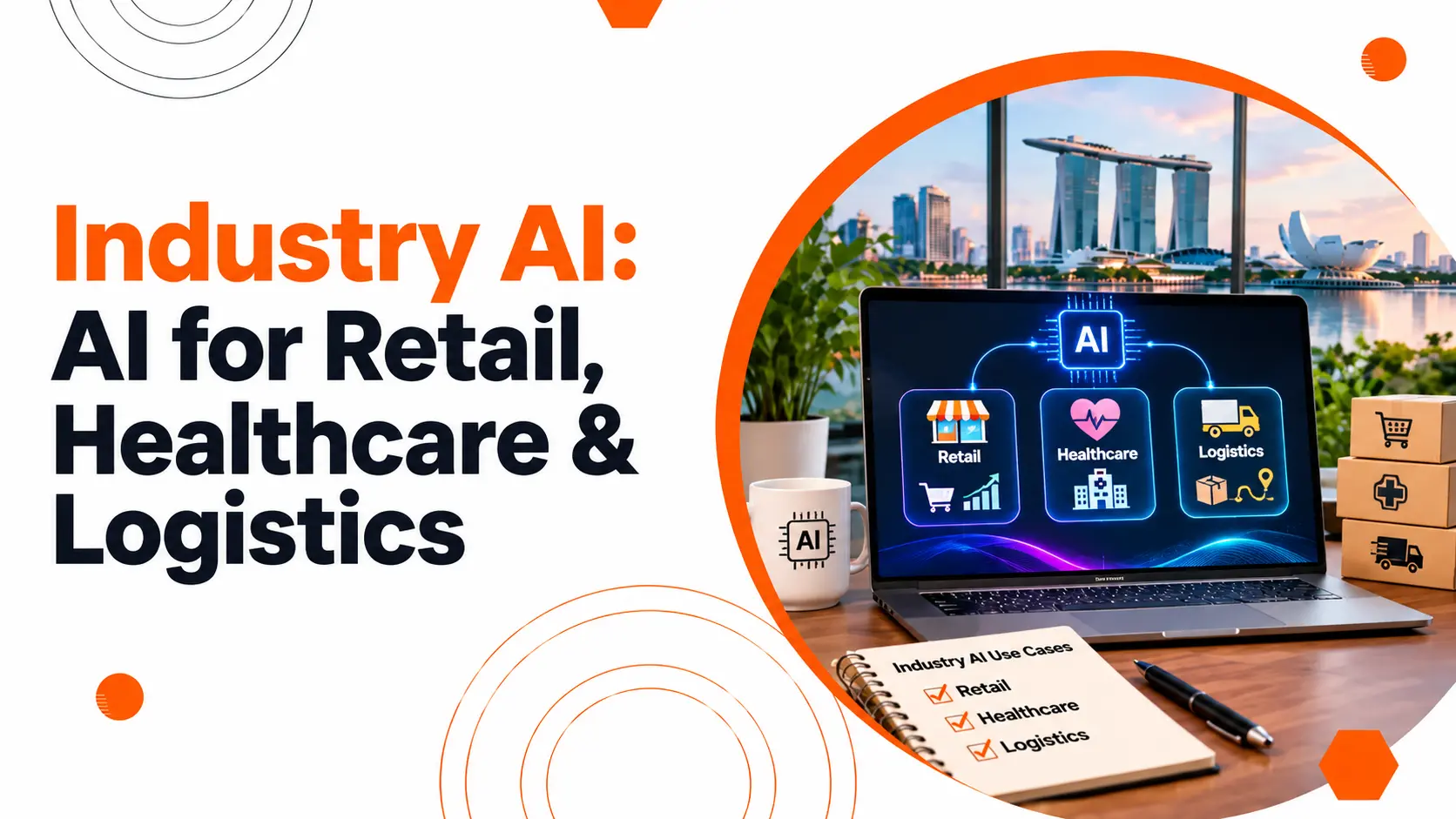
AI is no longer something that only large corporations can afford to explore. Small and medium-sized enterprises SMEs are also increasingly using it to run their day-to-day operations, to improve the customer experience, and to reduce the amount of time their staff spends on mundane tasks.
However, the way a retailer uses AI is going to be very different from the way a healthcare provider or a logistics company would use it. It’s all down to the nature of the business, the operational challenges, the customer expectations, and the way the business actually works.
From inventory management and dealing with customer queries through to scheduling medical appointments and planning delivery routes, AI can be used to solve all sorts of practical problems.
The increasing interest in AI for retail in Singapore businesses is indicative of a wider trend towards smarter, more efficient business operations across the board.
This guide looks at how SMEs in retail, healthcare and logistics can use AI, the benefits that it can bring and the government funding that is available to businesses in Singapore.
Build Custom Software That Fits Your Business
From CRM to inventory systems — we design solutions around your workflow, not the other way around.
What Is Industry AI?
Industry AI is the application of AI to meet the specific needs and solve the problems of a particular industry.
Rather than going in with a general AI tool and hoping it will solve everything, the approach is to build solutions around your own processes and your own operational requirements.
For instance, a retailer might use AI to forecast product demand, a healthcare practice to automate their appointment scheduling, and a logistics company to improve their delivery planning.
Understanding the various industry AI use cases enables business owners to spot where the technology can actually be of use. It helps them to avoid the mistake of simply going in and buying an AI tool because it’s the thing that’s all the rage at the moment.
AI for Retail: Improving Sales and Everyday Store Operations
Retail businesses in Singapore face a number of issues such as escalating operating costs, shifting customer preferences, and the threat from online stores. For retailers with small teams, it can be a real challenge to manage inventory, serve customers, and maintain sales.
The adoption of AI for retail Singapore businesses can help address these challenges without requiring a complete overhaul of existing operations.
1. Inventory Management and Demand Forecasting
Overstocking ties up your business capital and understocking can lead to lost sales.
AI can look at past sales, seasonal trends, and purchasing patterns to forecast future product demand. Retailers can then use that information to make better decisions around purchasing and restocking.
For instance, a clothing retailer can look at the anticipated increase in demand for certain items during the festive season and adjust their stock levels to meet that demand.
2. Personalised Product Recommendations
AI can look at customer browsing behaviour, their purchase history, and their preferences to recommend the right products.
An example would be an online skincare retailer suggesting other products to you based on what you’ve previously bought.
Relevant recommendations can enhance the shopping experience, drive repeat purchases, and potentially increase the average order value.
3. Automated Customer Support
Retail staff are constantly spending time answering queries about product availability, delivery dates, returns, and store policies.
AI-powered chatbots can deal with the more common queries outside of normal business hours. More complex requests can be escalated to an employee when human intervention is required.
4. Sales and Pricing Analysis
AI can identify the bestsellers, the underperformers, and shifts in buying behaviour.
Rather than going through the spreadsheets manually, the business owner can use the insights to plan promotions, review pricing, and make commercial decisions.
The practical benefits of AI for retail businesses Singapore retailers operate with better inventory visibility, reduced administrative work, and more responsive customer service.
AI for Healthcare: Supporting Better Patient Experiences
Healthcare providers are constantly managing a huge amount of information alongside their appointments, patient queries, and administrative responsibilities.
For smaller clinics and healthcare practices, these can be time-consuming tasks that take time away from patient care.
Here are some practical ways in which AI can support healthcare operations.
1. Appointment Scheduling and Reminders
AI-powered booking assistants can be used to check in patients, book appointments, and send reminders.
They can also help with rescheduling requests, thereby reducing the number of standard calls that reception will have to deal with.
Automated reminders may help to reduce the number of missed appointments and improve the efficiency of the scheduling process.
2. Patient Enquiry Management
Healthcare providers are regularly asked questions regarding consultation hours, the range of services available, how to book an appointment, and the matter of payment.
AI assistants can provide answers based on the approved clinic information and will then direct the patient to the appropriate department.
However, any queries relating to symptoms, diagnosis, or treatment advice should be referred to a qualified medical professional.
3. Medical Documentation and Administrative Work
AI can be used to help with document organisation, information extraction from forms and the preparation of administrative summaries.
For instance, a clinic could use AI to pull the relevant bits out of the registration form and thus eliminate the need for all that repetitive data entry.
Employees should still check the important bits before updating the patient records.
4. Resource and Operational Planning
Healthcare facilities can use historical appointment data to identify the busy periods, to estimate patient demand and to plan staffing levels.
This can help clinics to allocate their resources more effectively and manage patient waiting times.
When it comes to implementing AI for healthcare providers, Singapore businesses must prioritise patient confidentiality, data security and regulatory compliance. AI is there to assist the healthcare professional, not to replace their clinical judgement.
AI for Logistics: Making Deliveries and Supply Chains More Efficient
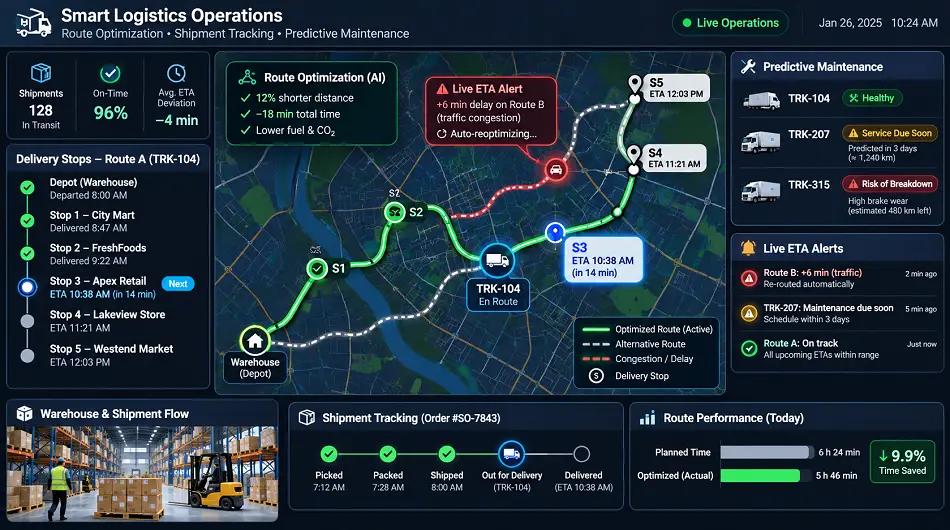
Singapore’s logistics companies are in a very fast-moving environment where the accuracy of delivery, the operating cost, and the timeliness of the shipment all have a direct bearing on customer satisfaction.
For SMEs managing a number of deliveries, a number of warehouses, or a number of transport schedules, AI can be of great help in making the day-to-day coordination of those activities a little easier.
1. Delivery Route Optimisation
AI can look at traffic conditions, delivery locations, vehicle capacity, and delivery schedules and recommend the most efficient routes.
For instance, a local delivery company doing a number of deliveries around Singapore could use route optimisation to cut down on the number of unnecessary trips and improve their delivery planning.
This could help to reduce fuel consumption and transport costs.
2. Warehouse and Inventory Management
AI can be used to support warehouse operations by identifying patterns in stock movement, forecasting demand, and recommending replenishment schedules.
Warehouse teams can also use intelligent systems to prioritise their picking and packing tasks, especially during busy periods.
3. Shipment Tracking and Customer Updates
Customers now expect accurate information as to when their order will arrive.
AI can be used to estimate delivery times based on the data available on the shipment and the operations. It can also be used to send out automated notifications to customers to let them know the status of their delivery or indeed if there’s a potential for a delay.
This reduces the need for staff to manually respond to every tracking query.
4. Predictive Maintenance
Logistics businesses are vehicle-, plant-, and warehouse equipment intensive.
Where you have sufficient equipment and sensor data available, AI can pick up on performance anomalies which may indicate a potential maintenance issue.
By fixing problems early, you can avoid surprise breakdowns and operational disruption.
Investing in AI for logistics companies can help with better use of resources, better delivery planning, and greater operational visibility.
How AI Applications Differ Across Industries
Although the technologies in use across the various industries are very similar, the objectives and requirements of the businesses in each of those industries are very different
| Business requirement | Retail | Healthcare | Logistics |
| Primary objective | Improve sales and customer experience | Support patient care and operational efficiency | Improve delivery and supply chain efficiency |
| Common AI applications | Demand forecasting and recommendations | Appointment scheduling and documentation | Route optimisation and shipment tracking |
| Key data sources | Sales and customer data | Patient and appointment records | Shipment and inventory data |
| Performance indicators | Sales, stock availability and customer satisfaction | Waiting times and administrative efficiency | Delivery accuracy and transportation costs |
| Key considerations | Customer privacy and forecast accuracy | Patient confidentiality and clinical safety | Tracking accuracy and system reliability |
Understanding the differences allows SMEs to pick an AI solution based on their actual business needs rather than just going with what’s in vogue in the industry.
Why Should SMEs Invest in Industry-Specific AI Solutions?
For SMEs, it’s about using AI to solve business problems rather than just keeping up with the next technological fad.
Some of the key benefits include:
- Reduced operational costs: Automating repetitive tasks will, of course, reduce the amount of manual work and hence reduce costs.
- Improved productivity: employees can spend far more time on the sorts of things that actually require human expertise.
- Better decision-making: AI can analyse business data and spot patterns that you wouldn’t necessarily spot yourself.
- Improved customer experience: quicker responses, more personalised service, and timely updates can all lead to a better customer experience.
- Business scalability: AI can assist businesses in managing increasing workloads without having to scale their admin resources at the same rate.
Business owners can also look at a range of AI agent use cases to see how intelligent assistants can be used to carry out tasks in customer service, administration, and a whole range of other business functions.
However, the benefits in reality are going to be entirely down to how well the technology is implemented, the quality of the data that’s available, and whether it actually solves a real business problem.
Government Grants for AI Adoption in Singapore: What SMEs Should Know
The cost of implementing AI can be a concern for smaller businesses. There is government funding available in Singapore for eligible companies to help them to adopt technology and enhance their capabilities.
However, businesses should be aware of the recent changes to the grants available.
How Can SMEs Get Started with AI?
Implementing AI doesn’t necessarily mean you have to replace all your existing software or go and transform every single department at the same time. It’s often more sensible and achievable to start with a very specific business problem in mind.
1. Identify Your Biggest Operational Challenge
Determine which activities are the biggest consumers of time, resources, and money.
A retailer could be struggling with their stock; a clinic could be spending all their time on appointments. That’s where you identify the problem, and that’s where you establish the purpose of having AI.
2. Assess Your Existing Systems and Data
Review your current software, your business processes, and the data that you have.
AI is all about having accurate and relevant information. Out-of-date records, inconsistent data, and disconnected systems can all have an impact on its performance.
3. Start with a Small Project
Start with a specific application such as automated customer enquiries or demand forecasting.
A smaller project enables you to assess performance, work out the cost of implementation, and get employee feedback prior to any expansion.
4. Choose Between Ready-Made and Custom AI Solutions
Ready-made tools will be adequate for the standard business use case. For companies with very specific workflows or complex integration requirements, custom AI software may be the way to go.
Reading anAI software development guide can go a long way to help business owners to get a feel for the development process, the technical requirements and the implementation issues before they actually go and spend the money.
5. Train Employees and Monitor Results
Employees should know how to use the AI tools, how to check the outputs, and how to deal with situations where human intervention is required.
Businesses should also be looking at the relevant performance indicators to establish whether the investment is actually delivering some tangible improvements.
What Should Businesses Consider Before Implementing AI?
AI has a number of advantages, but successful deployment is very much a matter of careful planning.
Businesses should also be looking at the cost of implementation and maintenance, software compatibility, data accuracy, and the readiness of the staff. Data protection is obviously paramount when you’re dealing with customer data, patient records, or any other form of confidential business data.
Compliance with Singapore’s PDPA and any applicable industry regulations should be an integral part of the implementation process.
Working with an experienced software development company will help you to identify the right applications, integrate AI with your existing systems, and put in place the appropriate security controls.
Conclusion: Build AI Solutions Around Your Business Needs
AI offers real opportunities for SMEs across retail, healthcare and logistics. If you’re looking at it in terms of improving your stock planning, making patient admin easier or cutting down on delivery inefficiencies, then the right AI solution will be one that addresses a very specific business need.
At Genic Solutions, we build bespoke AI software that is designed around your actual operational requirements, your existing systems, and your long-term business objectives. This can range from predictive analytics and intelligent automation right through to AI booking assistants. We help you to bring AI into your day-to-day operations.
Contact Genic Solutions today to explore how AI can support your business operations and growth.