Modern businesses in Singapore face one common challenge: teams spend too much time on repetitive work. From processing invoices to updating customer records, many daily tasks follow the same steps again and again. These activities take valuable time away from work that needs human thinking and decision-making.
This is where RPA Singapore solutions are gaining attention. Companies of all sizes are exploring ways to reduce manual effort, improve accuracy, and increase productivity without changing their existing systems.
In this guide, you’ll learn what RPA is, how it works, where it delivers value, and why it is becoming an important technology for SMEs and growing businesses across Singapore.
Build Custom Software That Fits Your Business
From CRM to inventory systems — we design solutions around your workflow, not the other way around.
What Is RPA?
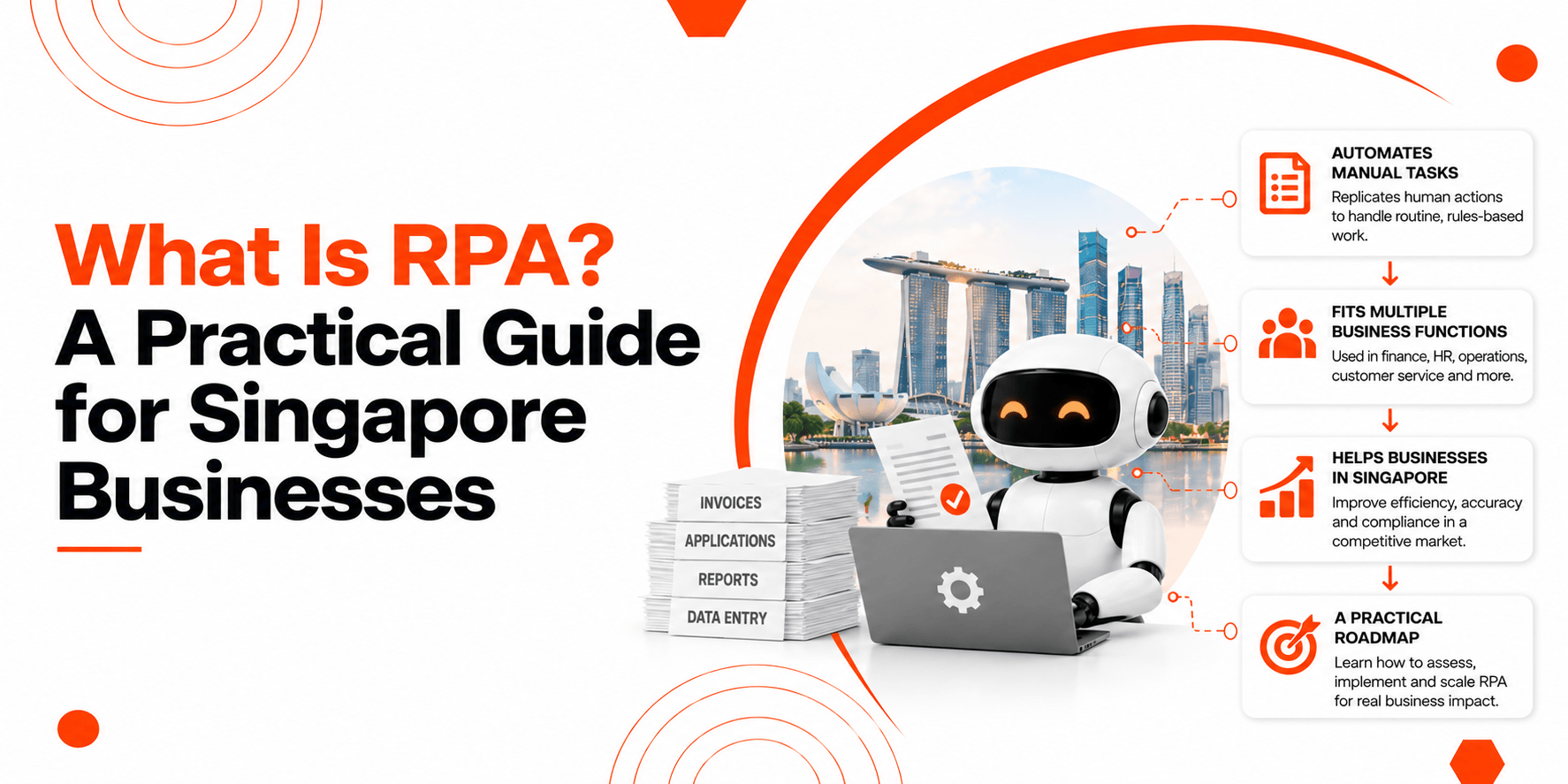
RPA, or robotic process automation, is a technology that uses software robots to perform repetitive digital tasks by following predefined rules.
Instead of replacing people, RPA handles routine work that employees usually complete on computers. It can copy data, fill in forms, generate reports, move information between systems, and complete many other structured tasks with speed and consistency.
For operations and IT managers, RPA offers a practical way to improve efficiency without rebuilding existing business processes from scratch.
What Makes RPA Different?
Think of RPA as a digital worker. It interacts with applications in much the same way as a person would. It clicks buttons, enters information, reads data from documents, and follows clear instructions.
Unlike traditional automation, it often works across different software platforms without requiring major changes to the systems already in use.
Key characteristics of RPA include:
- Rule-based task execution
- Consistent and accurate data handling
- Integration across multiple business applications
- Faster processing of repetitive workflows
- Reduced manual workload for employees
For many organisations, RPA Singapore initiatives begin with a single department before expanding across finance, HR, customer service, and operations.
How Does Robotic Process Automation Work?
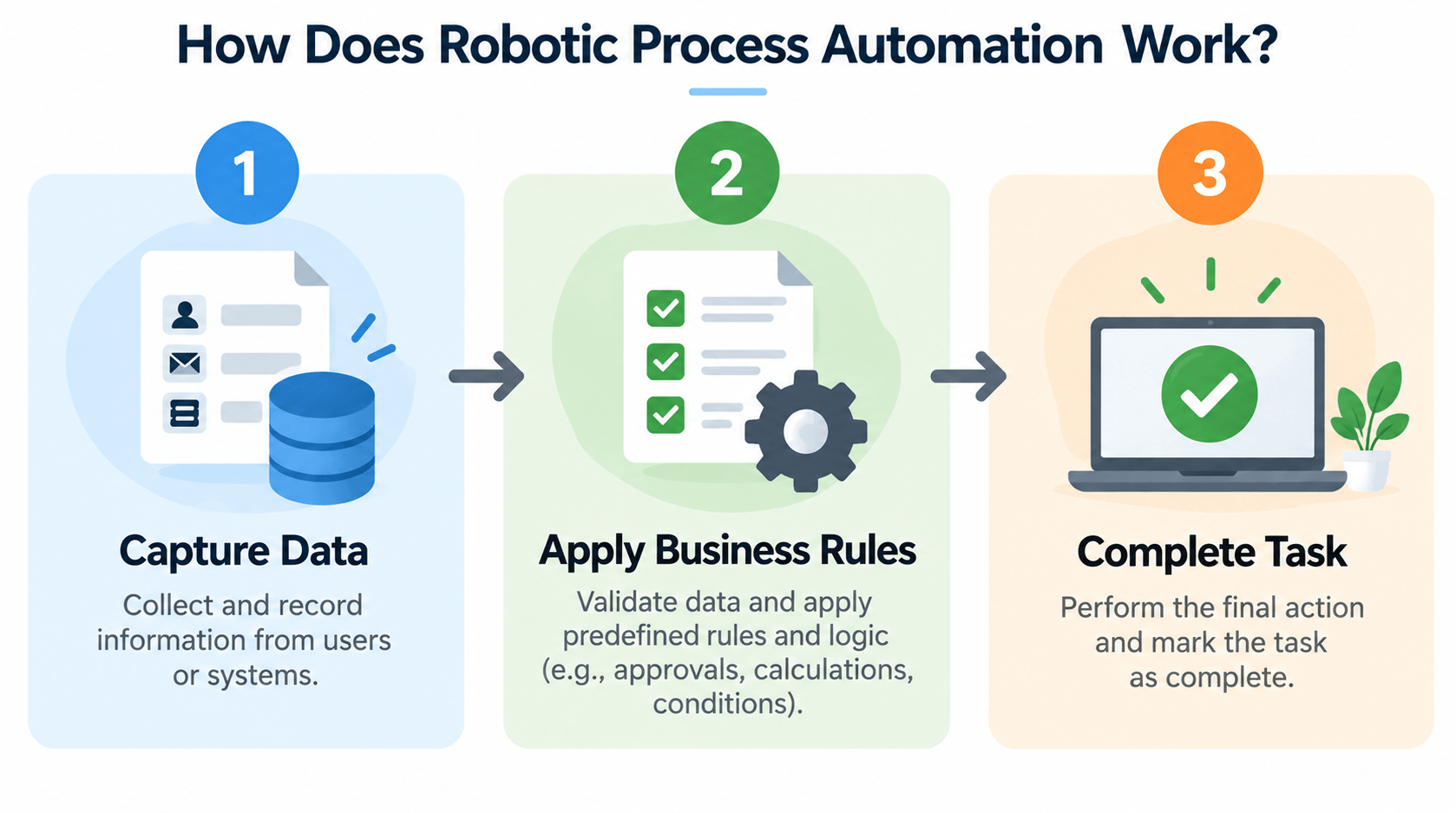
Robotic process automation works by observing a defined business process, creating rules for each step, and allowing software robots to complete those actions automatically.
The process is straightforward. A business identifies a repetitive task, maps the workflow, and defines the rules that the software robot should follow. Once deployed, the robot performs the task whenever it is triggered.
Step 1: Capture Information
The software receives information from sources such as emails, spreadsheets, forms, or databases.
Step 2: Apply Business Rules
It checks conditions, validates data, and decides the next action based on predefined rules.
Step 3: Complete the Task
The robot updates systems, creates records, sends notifications, or generates reports without manual input.
This explains what is RPA and how it works for SMEs in practical terms. Small and medium-sized businesses do not need complex infrastructure to automate routine office processes. They simply need well-defined workflows.
Why Are Singapore Businesses Investing in RPA?
Singapore businesses select RPA because it enables them to decrease their operating expenses while enhancing service delivery and supporting their digital transformation initiatives throughout their organisational units.
The cost of labor keeps going up while customers now demand better service than before. Teams need to process more work with the same resources. RPA solves this problem through its ability to perform all administrative duties that staff members must handle during their workday.
Operations managers receive their main benefit through the establishment of efficient operational systems. The value for IT managers emerges through their ability to enhance their operational processes while maintaining their present operational environment.
Organizations that want to measure their operational success while they do not want to replace their current systems find RPA Singapore projects highly appealing.
What Tasks Are Best Suited For RPA?
The best RPA tasks are repetitive, rule-based, and involve structured digital information. Not every business process should be automated. Tasks that require judgement, negotiation, or creative thinking remain human responsibilities. RPA performs best when every step follows a clear pattern.
Ideal Processes for Automation
- Invoice processing
- Purchase order creation
- Employee onboarding paperwork
- Payroll data updates
- Customer record management
- Report generation
- Inventory updates
- Compliance documentation
These activities consume hours each week across many Singapore businesses. Automating them creates more capacity for customer service, planning, and business growth.
What Are Some RPA Examples For Singapore Businesses?
RPA examples for Singapore businesses include finance automation, HR administration, customer support, logistics, and retail operations. Different industries use robotic process automation in different ways. The common goal remains the same: remove repetitive work while improving speed and accuracy.
Finance and Accounting
Finance teams often manage thousands of transactions each month.
RPA can automate:
- Invoice matching
- Payment reconciliation
- Expense validation
- Financial report preparation
This reduces processing time and improves audit consistency.
Human Resources
HR departments spend significant time handling employee records.
Common automated tasks include:
- New employee data entry
- Leave balance updates
- Benefits administration
- Document generation
This allows HR professionals to focus on employee engagement rather than paperwork.
Customer Service
Support teams need fast access to accurate customer information.
RPA helps by:
- Updating customer profiles
- Logging service requests
- Sending confirmation emails
- Routing enquiries to the correct department
Customers receive quicker responses while staff handle complex cases.
Logistics and Supply Chain
Logistics companies process large volumes of shipment data every day.
Automation supports:
- Delivery status updates
- Order tracking
- Inventory synchronisation
- Shipping documentation
These are practical RPA examples for Singapore businesses that improve operational visibility.
Retail and e-Commerce
Retail operations depend on accurate product and order information.
RPA can manage:
- Stock updates
- Price changes
- Order confirmations
- Sales reporting
This creates smoother operations during busy sales periods.
RPA vs Manual processes: Which is Better for Singapore Businesses?
The performance of RPA systems exceeds manual operations when handling repetitive tasks, but humans continue to play a vital role for tasks that require decision-making and direct client service.
Organizations evaluate their current workflows and automated systems before they decide to purchase new technological solutions. The evaluation process focuses on selecting the correct personnel for appropriate tasks instead of personnel termination.
The comparison reveals why operations teams need to understand RPA vs. manual processes in Singapore because they work in different operational spaces. The best results emerge when skilled employees work together with automated systems instead of choosing between human or machine control.
What is RPA and How Does it Work for SMEs?
RPA helps SMEs run their basic office operations through automation without they need to change their current business software programs.
Small and medium-sized businesses often assume automation is only suitable for large enterprises. The actual business operations of SMEs include numerous repetitive processes that show immediate potential for process improvement.
Where SMEs Gain The Most Value
Administration
- Data entry
- Document filing
- Internal reporting
Finance
- Invoice creation
- Payment tracking
- Bank reconciliation support
Sales operations
- Customer record updates
- Quote generation
- Order processing
The biggest advantage is time. Staff spend fewer hours on repetitive administration and more time supporting customers and growing the business.
What Benefits Does Robotic Process Automation Provide?
Robotic process automation delivers faster processes, better accuracy, lower operational costs, and improved employee productivity.
The benefits extend beyond simple time savings. Well-designed automation creates stronger business processes that are easier to monitor and improve.
Higher Productivity
Employees no longer repeat the same administrative tasks throughout the day. They can focus on planning, customer relationships, and problem-solving.
Better Accuracy
Software robots follow the same rules every time. The system decreases input errors while maintaining uniform data throughout various operational platforms.
Faster Turnaround Times
Systems that operated at hour-long speeds now achieve minute-long completion because they support multiple operational systems.
Stronger Compliance
Organizations operating in various sectors need to maintain correct data records along with recorded operational procedures. RPA establishes stable process operations through its capability to generate precise tracking systems that record every step during execution.
Easier Scalability
Organizations choose to automate their increasing transaction operations because they want to stop performing repetitive manual tasks.
Businesses can automate more operational processes instead of increasing their manual work operations when transaction volumes start to increase.
For organisations planning wider software development projects, automation also supports better integration between business systems and operational processes.
What Challenges Should Businesses Consider Before Adopting RPA?
Businesses should evaluate process quality, workflow consistency, employee readiness, and long-term maintenance before implementing RPA.
Automation works best when the underlying process is already well organised. Automating an inefficient workflow simply repeats the same inefficiency at greater speed.
Important Considerations
Is the process clearly documented?
Every step should be consistent and easy to define. Frequent exceptions reduce automation effectiveness.
Does the data follow standard formats?
Structured information is much easier to automate than inconsistent or incomplete records.
Are employees prepared for change?
Successful projects involve staff from the beginning. Teams understand the process better than anyone and often identify the best automation opportunities.
Can the workflow grow over time?
Start with one high-volume process, measure results, and expand gradually. This approach reduces implementation risk and builds confidence across departments.
How Can Operations and IT Managers Start an RPA Project?
The best way to start an RPA project is to identify one repetitive process, measure its current performance, and automate it in stages.
A phased approach delivers quicker results and creates a stronger business case for future automation.
Step 1: Identify Repetitive Work
Look for tasks that happen every day or every week. High-volume administrative work usually offers the strongest return.
Step 2: Measure the Current Process
Track:
- Processing time
- Error rates
- Staff effort
- Transaction volume
These metrics provide a baseline for improvement.
Step 3: Prioritise by Business Impact
Select processes that operate at high volume levels while delivering direct business value through activities like invoice processing and customer information maintenance.
Step 4: Test Before Scaling
Start with one department to test the workflow system, and then you can make process improvements before expanding the system to other organisational units.
Step 5: Continue Improving
The system requires ongoing development because automation projects do not reach completion after their initial phase. Organisations conduct routine assessments to discover fresh business opportunities while they work to enhance their current operational processes and develop their software solutions.
Conclusion
Overall, systems like RPA in Singapore function as the most suitable solution for businesses that dedicate extensive periods to performing automated digital operations with fixed operating procedures.
The use of automation technology has expanded past its original boundaries because Singapore businesses now operate outside of the large enterprise sector. Organizations including SMEs, growing businesses, and established companies can achieve better results by taking away their daily repetitive work responsibilities.
The highest value emerges when we develop better work methods for people instead of substituting them with automation. The automation of standard procedures enables staff members to dedicate their time toward serving customers, creating strategic plans, and enhancing business operations.
Singapore’s digital transformation requires organisations to use RPA in Singapore as their initial step because these initiatives help operations and IT managers achieve measurable results in operational efficiency, scalability, and accuracy that will drive their business expansion.