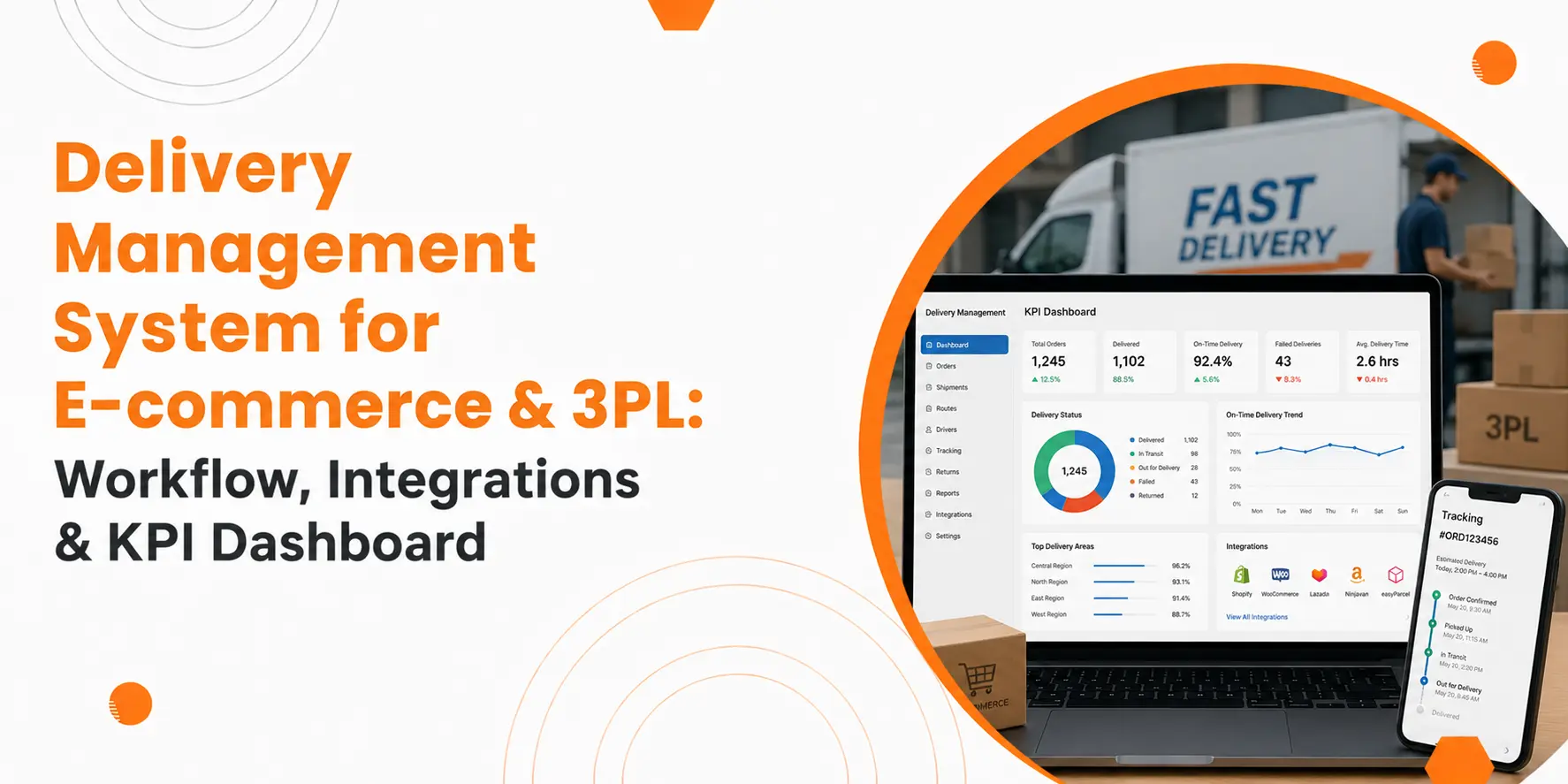
A delivery management system in Singapore helps e-commerce businesses and 3PL providers manage orders, plan routes, assign drivers, track deliveries, connect business systems, and monitor performance from one central platform.
It helps businesses organise deliveries, reduce delays, improve visibility, and make better decisions through real-time information.
In this guide, we will explore how a delivery management system works, the role of integrations, the delivery workflow, and the key performance indicators (KPIs) that help businesses measure success.
Build Custom Software That Fits Your Business
From CRM to inventory systems — we design solutions around your workflow, not the other way around.
What Is a Delivery Management System?
A delivery management system is a digital platform that helps businesses plan, manage, track, and complete deliveries from order creation to final delivery.
Instead of handling deliveries through manual spreadsheets, phone calls, or paper records, businesses can manage every stage from one central platform.
A typical system helps businesses:
- Receive delivery orders
- Assign drivers
- Plan delivery routes
- Track vehicles in real time
- Send delivery updates
- Collect proof of delivery
- Monitor delivery performance
For both online retailers and logistics providers, a delivery management system in Singapore creates a smoother process while reducing errors.
Why E-commerce and 3PL Companies Need Better Delivery Control
E-commerce and 3PL companies need better delivery control to reduce delays, manage growing order volumes, improve tracking, and meet customer expectations.
Online shopping continues to grow across Singapore. Customers expect same-day or next-day delivery with accurate tracking.
3PL providers need to handle delivery operations for their multiple client accounts through their service system. The delivery needs of each customer include separate timing requirements, distinct operational areas, and individual client satisfaction demands.
Without proper systems, businesses often face:
- Late deliveries
- Missed delivery windows
- Poor route planning
- Limited shipment visibility
- High transport costs
- Manual reporting
- Customer complaints
Using delivery management software in Singapore allows businesses to manage these challenges with greater control and consistency.
How a Delivery Management System Works
A delivery management system works by connecting order creation, route planning, driver assignment, live tracking, and proof of delivery in one organised workflow.
Order Creation
The process starts when a customer places an order through an online store, marketplace, or customer service team.
Order details usually include:
- Customer information
- Delivery address
- Product details
- Delivery date
- Delivery instructions
The system stores this information and prepares it for dispatch.
Order Verification
Before dispatch, the system checks whether:
- Products are available
- Addresses are complete
- Delivery areas are covered
- Delivery schedules are available
This helps prevent failed deliveries.
Route Planning
Once orders are ready, the system groups deliveries based on location, delivery windows, vehicle capacity, and driver availability.
Better route planning helps reduce:
- Fuel usage
- Travel distance
- Delivery time
- Driver workload
This stage forms an important part of the ecommerce delivery workflow in Singapore, where fast deliveries often influence customer satisfaction.
Driver Assignment
After routes are created, jobs are assigned to suitable drivers.
Assignments may consider:
- Vehicle type
- Delivery location
- Driver schedule
- Parcel size
- Delivery priority
This helps balance workloads across the fleet.
Live Delivery Tracking
Once drivers leave the warehouse, businesses can monitor delivery progress in real time.
Tracking provides updates such as:
- Vehicle location
- Delivery status
- Estimated arrival time
- Delays
- Completed deliveries
Customers also benefit from better visibility throughout the journey.
Proof of Delivery
When the parcel reaches its destination, drivers can collect digital confirmation such as:
- Customer signature
- Delivery photo
- QR code confirmation
- Delivery notes
This creates a complete delivery record for future reference.
What is the Workflow for E-commerce Businesses
The e-commerce delivery workflow covers order receipt, warehouse picking, packing, scheduling, delivery, and final confirmation.
An efficient DMS for ecommerce in Singapore supports every stage of order fulfilment.
Step 1: Customer Places an Order
Orders enter the delivery queue from the online store.
Step 2: Warehouse Picks the Order
Warehouse staff prepare items for packing.
Step 3: Parcel Is Packed
Products are packed, labelled, and made ready for dispatch.
Step 4: Delivery Is Scheduled
The system selects the best delivery route and assigns a driver.
Step 5: Parcel Is Delivered
Drivers complete deliveries while updating delivery status.
Step 6: Delivery Confirmation
Customers receive proof of delivery, and the order closes automatically.
This structured workflow reduces manual work and improves operational efficiency.
What is the Workflow for 3PL Operations?
The 3PL workflow brings together orders from several clients, combines suitable deliveries, assigns fleet resources, tracks progress, and produces performance reports.
Logistics providers manage deliveries for many businesses at the same time. This makes planning more complex.
Good 3PL delivery software helps manage different customer accounts from one platform.
A common workflow includes:
Receiving Orders from Multiple Clients
Orders arrive from different businesses throughout the day.
Consolidating Deliveries
Orders travelling in similar directions are grouped.
Planning Routes
Routes are created to reduce travel distance while meeting delivery commitments.
Fleet Management
Vehicles are assigned according to parcel volume and delivery locations.
Driver Management
Drivers receive delivery schedules and customer details.
Delivery Monitoring
Operations teams monitor deliveries throughout the day and respond to delays when needed.
Performance Reporting
Completed deliveries generate reports that clients can review.
This structured process allows logistics providers to handle larger delivery volumes without increasing manual work.
Why System Integrations Matter
System integrations matter because they allow order, customer, inventory, delivery, and payment data to move between business systems without repeated manual entry.
A delivery platform performs best when connected with other business systems. reduce duplicate work and improves data accuracy. Some common integrations include:
E-commerce Platforms
Order information moves directly into the delivery system without manual entry.
Warehouse Management Systems
Inventory updates remain synchronised with delivery schedules.
Enterprise Resource Planning (ERP)
Business operations stay connected across finance, inventory, purchasing, and logistics.
Customer Relationship Management (CRM)
Customer information remains accurate across sales and delivery teams.
Accounting Systems
Completed deliveries can support invoicing and payment processes.
These integrations create one connected workflow instead of isolated systems.
What Should a Delivery KPI Dashboard Measure?
A delivery KPI dashboard should measure delivery speed, success rates, costs, driver performance, fleet use, failed deliveries, and customer feedback.
Managing deliveries becomes much easier when businesses measure the right performance indicators.
A KPI dashboard provides a clear view of daily operations.
On-Time Delivery Rate
This metric tracks the percentage of deliveries that arrive within the originally scheduled delivery time window.
Delivering products on time will improve customer satisfaction.
Delivery Success Rate
The system monitors successful delivery numbers against delivery failures that occur during delivery attempts.
The process of identifying recurring delivery problems allows businesses to enhance their delivery scheduling methods.
Average Delivery Time
This KPI tracks the duration between when a package leaves the warehouse until it reaches its destination.
The reduction of delivery times leads to better customer experiences.
Cost Per Delivery
Businesses can monitor transport costs for each completed delivery.
The reduction of delivery expenses leads to better profit margins.
Driver Productivity
This measures:
- The number of deliveries which drivers finish during their work shifts
- The total distance which drivers cover during their operational hours
- The complete duration which drivers spend on the road for their assigned duties
- The percentage of deliveries which drivers successfully finish
- Managers can identify opportunities for better resource planning.
Fleet Utilisation
Fleet utilisation measures how effectively vehicles are used during daily operations.
Companies can reduce their transportation expenses through better utilisation of their existing resources.
Customer Feedback
Customer ratings and feedback help identify service quality issues.
The data enables organisations to keep enhancing their processes through continuous improvement.
Failed Delivery Rate
Monitoring failed deliveries helps businesses identify common causes such as:
- Incorrect addresses
- Customer absence
- Poor route planning
Reducing failed deliveries saves both time and cost.
What are the Benefits of Delivery Management Software
Delivery management software gives businesses better visibility, faster decisions, lower costs, less manual work, and stronger customer communication.
Using delivery management software offers advantages across every stage of logistics.
Better Visibility
Operations teams know where every delivery stands throughout the day.
Faster Decision Making
Real-time information helps managers respond quickly to delivery issues.
Reduced Manual Work
Automation removes repetitive tasks such as data entry and manual scheduling.
Improved Driver Efficiency
Drivers receive clear delivery instructions and optimised routes.
Lower Operating Costs
Better route planning helps reduce fuel consumption and vehicle wear.
Stronger Customer Communication
Customers receive delivery updates throughout the process.
This reduces support enquiries and builds trust.
What Challenges Businesses Can Solve
Businesses can use a modern delivery solution to address delays, poor visibility, manual reporting, rising costs, and customer complaints.
Many organisations face similar delivery challenges regardless of size.
A modern delivery solution helps address:
Delivery Delays
Better scheduling and route planning reduce unnecessary delays.
Limited Visibility
Live tracking provides clear information throughout the delivery journey.
Manual Reporting
Reports are generated automatically from delivery data.
Rising Transport Costs
Smarter route planning reduces fuel usage and unnecessary mileage.
Customer Complaints
Clear communication and accurate delivery updates improve customer confidence.
How to Choose the Right Delivery Management Solution
Choose a delivery management solution by checking its ease of use, ability to scale, integration options, reporting tools, mobile access, and customer notification features.
Some important factors include:
Ease of Use
Staff should be able to learn the platform without extensive training.
Scalability
The system should support future business growth.
Integration Options
It should connect with existing business systems.
Reporting Features
Clear dashboards help management make informed decisions.
Mobile Access
Drivers should receive delivery updates from mobile devices.
Customer Notifications
Customers benefit from delivery updates and estimated arrival times.
What Is the Future of Delivery Operations?
Delivery expectations continue to change. Businesses must improve speed, visibility, and service while controlling costs.
Future delivery operations will focus on:
- Better route optimisation
- Greater automation
- Improved fleet visibility
- Stronger data reporting
- Faster customer communication
Businesses that invest in modern delivery processes will be better prepared for growing customer expectations.
For more insights into industry developments, explore Delivery Management Software Trends to understand how delivery operations continue to evolve.
You can also read DMS Improves Customer Experience to learn how better delivery management strengthens customer satisfaction and long-term loyalty.
Conclusion
A reliable delivery management system in Singapore helps e-commerce businesses and logistics providers manage deliveries with greater accuracy, visibility, and efficiency. The system tracks every step from order initiation until customers receive their proof of delivery.
Businesses that handle online orders and deliver services to multiple customers find their operations become more efficient when they unite their systems and establish direct business connections with each other.
Businesses can track their essential metrics through KPI dashboards, which simultaneously display vital information about system performance and development areas, helping them make better operational decisions. Businesses in Singapore need to invest in delivery management software because customer demand for service keeps rising, which will help them build better delivery operations and prepare for upcoming business expansion.
Organisations that want to improve their ecommerce delivery operations in Singapore need to develop a delivery process system for their 3PL delivery software to establish dependable service, which leads to business growth.